Posting here has been light, of late. And I apologize. But there is a very good reason.
Earlier this month, I was named Assistant Editor over at Greater Greater Washington. That has increased my responsibilities and time commitment there, and has decreased the amount of time I have to write at Track Twenty-Nine.
That said, I have no intention of abandoning T29. I plan to keep putting content here, but I doubt I'll be able to maintain the level of posting I had been doing in the past.
I am still writing, though. I generally write several posts a month for GGW. Many of those are specific to the Washington region. but some cover topics that are of interest to a wider group. If you want, you can subscribe to just my posts at GGW.
I would, of course, encourage you to subscribe to all GGW posts. David Alpert has put together an excellent team of writers, and I think you'll find many of their posts engaging and thought-provoking.
And speaking of GGW's influence, I am mentioned (and quoted) a few times in a great article in the Washington City Paper on how David Alpert is helping to shape Washington.
Thanks to all of you for reading! I'll continue to do my best to write about the issues that are important to me and to you.
Monday, September 20, 2010
Tuesday, August 10, 2010
Higher Ground
 I recently had the week off, and I took the opportunity to travel to Southern California. It was my first trip there.
 Generally when visiting a new place, one of the first things I try and do is find a high point to view the city I'm in. And in Los Angeles, one place stands out among the rest as a place to go: Griffith Observatory.
Standing high up on Mount Hollywood, the observatory offers extraordinary views across the Los Angeles Basin. I visited last Sunday evening, just as the sun began to get low in the sky, and stayed until well after dark.
And the views of the city were well worth the trip. The show at the planetarium was also superb. If you ever go to LA, make sure to visit the Griffith Observatory. LADOT offers a shuttle from the Vermont/Sunset Red Line station every 35 minutes or so on weekends. You can also hike, bike, or (if you must) drive there.
Anyway, more on my experiences and observations from Los Angeles and San Diego later. For now, I'll just show you some pictures from the Observatory.

Looking toward Century City

The Hollywood Hills (and Sign)

Downtown

The Hollywood Sign framed by one of the arches outside the Observatory

Sunset

The Basin

Downtown again

From the roof
Thursday, June 3, 2010
Park Police take the wrong approach to safety
 Besides closing park bike paths at dark for the "safety" of cyclists, the Montgomery County Park Police have taken another interesting approach to promoting cyclist and pedestrian safety.
This mobile variable message display board has been placed directly on the Sligo Creek Trail near Silver Spring. It's message: "Drive Safely / Crosswalk Ahead / Share the Road." Well, we wouldn't have to share the road if Park Police didn't block the trail with a sign, now would we?
Of course, as a cyclist, I appreciate that the Park Police are encouraging drivers to be on their best behavior. Their hearts are in the right place, but their effort is a bit - ah - misplaced.
Wednesday, May 26, 2010
Streetcar Funding Restorted
It's been a crazy day here in Washington, with the sudden news of the stripping of funding for the H Street Streetcar. However, after a torrent of phone calls and emails, the DC Council has reversed their decision and found the $47 million needed for the line.
Black Wednesday
 This morning, the DC Council voted to strip $49 million from the Streetcar program. This budget change was made by the Chariman, Vincent Gray, at 2:00 am the morning of the vote. There was no time for public or council discourse on the issue.
Despite the fact that streetcar rails have already been laid between Oklahoma Avenue and downtown, the DC Council has decided that H Street, devastated in the 1968 riots, does not deserve a second chance at life.
This move jeopardizes the H Street Streetcar and the rest of the streetcar program. The line on H Street was supposed to open in 2012 as a part of a 37-mile District-wide system. The Anacostia Line demonstration project, which was supposed to open in 2006, remains under construction.
Update:
The Council has restored funding to the H Street Streetcar. They were inundated with calls and emails.
Monday, May 10, 2010
Metro's terminal-based wayfinding confusing for visitors
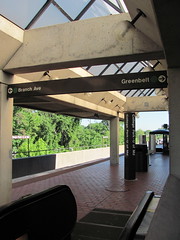 For out-of-towners, navigating the Metro system can be a daunting task. Metro could make directions easier and improve wayfinding in the system by providing more information about train directions on signs.
The system's use of colored lines and destination station to identify train direction works fairly well for Metro, especially given the structure of the system, but it can be confusing to see one train going to Glenmont and another to Grosvenor when neither mean much to a visitor.
Where some trains don't go all the way to the terminal, like on the Red Line, the multiple terminals are even more confusing, especially when two Red Line terminals are two-word names starting with 'S' and the others one word starting with 'G', but one of each is on either end of the line. Other lines downtown also have two terminals in each direction since two colors share a track.
What could Metro do? Other transit systems approach this problem in several ways.
Read More-->
Wednesday, May 5, 2010
DC Puts Streetcar on Display
I just finished visiting the DC Streetcar brought down from Greenbelt yard. I've uploaded a few photos, with more to follow later. You can view my pics here:
If you're in the DC area, the streetcar will be on display at the Old Convention Center site (9th & H NW) from 11-7 though Saturday, except that it closes at 5p on Saturday.
Thursday, April 29, 2010
7000-Series Hiccups and Missed Opportunities
In case you missed it, I published two new posts about the 7000-series on Greater Greater Washington this week.
The first looks at some hiccups in the process, including MWAA's dispute with Metro over costs (which could delay or derail the contract) and Maryland's delinquency, which seems to be nixing the testing/commissioning facility necessary for the new cars.
And the second post looks at significant missed opportunities with the 7000-series, including not adding more doors, failure to transition to articulated trainsets, and a loss of design element uniformity.
The first looks at some hiccups in the process, including MWAA's dispute with Metro over costs (which could delay or derail the contract) and Maryland's delinquency, which seems to be nixing the testing/commissioning facility necessary for the new cars.
And the second post looks at significant missed opportunities with the 7000-series, including not adding more doors, failure to transition to articulated trainsets, and a loss of design element uniformity.
Monday, April 26, 2010
The 7000 series: Not your father's railcar
 Metro will soon place an order for a new series of railcars. The new cars, the 7000 series, will be quite different from Metro's current fleet of cars.
One notable difference with the cars is that they will be quad-sets. They will still be married pairs, like WMATA's current rolling stock, but instead of having a cab at each end of the pair, a cab will only be present at one end.
A second married pair facing the opposite direction will give the set of four a cab at each end. By eliminating cabs in half the cars, this configuration will give the cars more passenger capacity. A control panel will be located at the other end of each pair to facilitate movement in yards.
Read More-->
Image from WMATA


You Don't Auto-Complete Me
A few minutes ago, I went to Google Maps to find the location of the Chevy Chase Library relative to the Capital Crescent Trail.
With the address in hand, I began typing. It's located at 8005 Connecticut Avenue. On the map below, that's at the intersection of Connecticut and Dunlop.

When I started typing, Google tried to be helpful. "Bulgaria, is that where you're looking? No? Italy? Japan, maybe?"
I mean, my map is already hovering over the area where the library is! I just wanted an exactish location. None of the top 10 suggestions are even in the Western Hemisphere!
Come on Google, you can do better than that, can't you? Ever consider that someone might be typing an address into a maps application?
With the address in hand, I began typing. It's located at 8005 Connecticut Avenue. On the map below, that's at the intersection of Connecticut and Dunlop.

When I started typing, Google tried to be helpful. "Bulgaria, is that where you're looking? No? Italy? Japan, maybe?"
I mean, my map is already hovering over the area where the library is! I just wanted an exactish location. None of the top 10 suggestions are even in the Western Hemisphere!
Come on Google, you can do better than that, can't you? Ever consider that someone might be typing an address into a maps application?
Saturday, April 10, 2010
Read This
I know my posting's been down lately. I'm working on trying to improve. I have been writing a lot more for Greater Greater Washington and not crossposting here, so if you aren't subscribed to me there, consider signing up for GGW's RSS feed or just the RSS for my posts.
Anyway, I know that I've done a terrible job keeping my sidebar links up to date, and unfortunately, I don't have time for an update at the moment. However, I think all of you interested in transit or planning (or policymaking) should take a moment right now and visit Human Transit.
Human Transit is one of the best blogs I've come across about general transit planning commentary. It's one of the most valuable entries in my RSS feed. And at about a post a day, the information is quality but which does not overwhelm with volume, which can be a problem on other sites.
Here are a few of the posts that I really enjoyed (in order by date of posting, newest first):
Anyway, I know that I've done a terrible job keeping my sidebar links up to date, and unfortunately, I don't have time for an update at the moment. However, I think all of you interested in transit or planning (or policymaking) should take a moment right now and visit Human Transit.
Human Transit is one of the best blogs I've come across about general transit planning commentary. It's one of the most valuable entries in my RSS feed. And at about a post a day, the information is quality but which does not overwhelm with volume, which can be a problem on other sites.
Here are a few of the posts that I really enjoyed (in order by date of posting, newest first):
- streetcars vs light rail ... is there a difference?
- vancouver: the great broadway debate
- the power and pleasure of grids
- frequency and freedom on driverless rapid transit
- unhelpful word watch: captive rider
- the "transit isn't green because it runs empty" line
- arrival by train: how end stations differ from through stations
- paris rapid transit: the four levels of nomenclature
Wednesday, March 31, 2010
Prince George's residents speak out against bus cuts
 Crossposted at Greater Greater Washington
Riders filled the Prince George's County WMATA budget hearing on Monday despite a suburban and relatively transit-inaccessible location, and made heart-wrenching please to retain their vital lifelines, bus service.
At least 100 riders attended and over 40 people gave testimony. Board Member Elizabeth Hewlett and General Manager John Catoe were both present to listen to the riders.
Many of the commenters called on elected officials to pitch Maryland's contribution in. Many audience members wore "O'Malley: Stop Bus Cuts" pins created by the Transit Riders United of Greenbelt, and said that if bus service is cut, they won't vote for O'Malley again.
Almost all of the speakers were strongly opposed to any cuts in bus service. Two blind Greenbelt residents, Laura and Shawn O'Neil, testified about the hardships cuts would bring them. Currently, they have two buses which serve both Greenbelt Metro and New Carrollton Metro. Under Metro's proposal, they will lose their service to New Carrollton, where one of them works, on both routes. His only option will be to switch from fixed route service to paratransit, at a cost of approximately $19,000 per year to Metro.
I overheard a Metro planner speaking with Ms. O'Neil in the audience prior to the hearing. Instead of offering her alternatives or even attempting to understand her condition, he blithely told her that she could find a way to cope with the changes. He completely blew off her concerns that transferring between buses in a strange place with poor pedestrian accommodations would be difficult for a blind person, and left her in tears. With representatives like this, it's no wonder the community doesn't have a lot of faith that WMATA actually listens to customers.
One speaker asked the WMATA panel if they ever wondered if paratransit (MetroAccess) costs were so high in Prince George's because the fixed route service was so abysmal. That comment got quite a few nods through the room.
A few citizens came forward to speak out against the elimination of the R3 bus, which serves the National Archives facility in Adelphi. Some riders in the area will be left without service at all times, others would lose service on weekends and off-peak. They spoke of the importance of continuing to have good access for visitors, researchers, and employees at the National Archives, and also of the general importance that transit plays in keeping livable communities accessible.
Other riders spoke out against fare increases. Some talked of the hardship of the additional cost of their commute, others were opposed to giving more money to an agency in which they have little faith. Some spoke of the waste they think exists in the agency, while others criticized what they characterized as the overpayment of workers and lack of oversight of Metro.
The meeting was at times boisterous, with applause and the occasional 'amen' from those in the audience. It was at all times civil. Most speakers stayed within the 3 minutes alloted for testimony.
Metro provided a shuttle from New Carrollton station to the hearing, which ran continuously during the proceedings. Additionally, the city of Greenbelt organized a bus to take residents to the hearing.
However, citizens who didn't know about the shuttles, might have been discouraged by the lack of regular service by the hearing site. Only one bus route, the F13, serves the church where the meeting was held, but the last return trip to New Carrollton passes by the church at 6:35 — 25 minutes before the hearing started.
Additionally, as several commenters at the hearing noted, even with shuttle service back to New Carrollton, the lack of decent bus service would make it difficult or impossible to return to their homes. One blind citizen criticized Metro for the location of the hearing, saying that they should be "ashamed" that there were no hearings held in southern Prince George's.
In fact, of the 6 budget hearings held in the region, the only one south of Route 50 is the one in Southeast Washington. The same commenter said that cross-county bus service was a "joke" and that was why the hearing didn't have even more citizens there to testify.
Many Greenbelters turned out, which is to be expected since Metro has proposed restructuring all bus service in the city, including the elimination of one route (the R3), the truncation of another (the C2), and the restructuring of the R12 and T16/17. And while no official notice has been given, some feel that Metro's restructuring makes it more likely that Prince George's County Transit will discontinue at least one route, the 15.
Many of the Greenbelters were members of Transit Riders United, which for over 6 months has been working with Metro and Prince George's County planners to improve bus service in Greenbelt. In December, members tell me, they were informed that Metro had a proposal, but couldn't release it until it was okayed by Prince George's. The plan was finally released late last week, less than a week before the hearing, and with little time to consider the implications or find alternatives.
After the meeting, I spoke with one WMATA representative, who was surprised that there were not more positive comments, especially about some of the changes in the Greenbelt area. I told him that with only three minutes each, most citizens were bound to focus first on the changes most harmful to them, and then if there was time left over, they would get around to positive comments.
Above photo by thisisbossi on Flickr
Note: Commenting has been disabled. Please continue the conversation at Greater Greater Washington.
Sunday, March 28, 2010
Highways After People
On Sunday, I had the opportunity to travel to Breezewood, Pennsylvania to bike on a portion of the Abandoned Pennsylvania Turnpike. Check out my photos below.
This stretch of the abandoned turnpike is 13 miles long, and was abandoned in 1968. It includes two tunnels, Rays Hill and Sideling Hill. I had hoped to bike the whole segment, but rain set in, and the trip had to be cut short.
So, the trip only included a ride through the Sideling Hill Tunnel, 1.3 miles of inky darkness.
This stretch of the abandoned turnpike is 13 miles long, and was abandoned in 1968. It includes two tunnels, Rays Hill and Sideling Hill. I had hoped to bike the whole segment, but rain set in, and the trip had to be cut short.
So, the trip only included a ride through the Sideling Hill Tunnel, 1.3 miles of inky darkness.
This section of the Turnpike opened in 1940, and was bypassed in 1968 because it was cheaper than twinning the two tunnels. It's an eerie site. It's out in the middle of nowhere, and seems some remnant of a post-apocalyptic world. The whole time we spent on the old turnpike, we saw only two other people, local teens by the look, emerging from the darkness on foot.
The tunnels actually date back to 1881 and the construction of the South Penn Railroad, which went bust before completion. In the late 1930s, the Pennsylvania Turnpike Commission completed and expanded the tunnels.
However, most of the railroad line follows a different alignment from the Turnpike. In places, you can see traces. Several photos in my set show the railroad grade (and a culvert) just west of the western portal of the Sideling Hill Tunnel.
Monday, March 22, 2010
Downtown bike lane proposal needs fixes at the ends
Crossposted at Greater Greater Washington
 Last week, DDOT announced a plan for a set of cutting-edge bike facilities downtown, but the plan does raise some issues. The plan will dramatically improve cycling conditions downtown, but some of the constraints on the plan may call for even more innovative solutions.
One of the concerns voiced at Thursday's meeting was about what happens to the bike lanes on I (Eye) and L Streets when they end at the diagonal avenues (Pennsylvania Avenue at the west end of I, Massachusetts Avenue at the east end of L).
Because the bike lanes run on the left side of the east-west streets, cyclists will either be expected to turn into the left lanes of Pennsylvania and Massachusetts Avenues or find some other way of crossing several lanes of traffic to get to the right curb.
More->
*Note: Commenting has been disabled. Please continue the discussion at Greater Greater Washington.
Last week, DDOT announced a plan for a set of cutting-edge bike facilities downtown, but the plan does raise some issues. The plan will dramatically improve cycling conditions downtown, but some of the constraints on the plan may call for even more innovative solutions.One of the concerns voiced at Thursday's meeting was about what happens to the bike lanes on I (Eye) and L Streets when they end at the diagonal avenues (Pennsylvania Avenue at the west end of I, Massachusetts Avenue at the east end of L).
Because the bike lanes run on the left side of the east-west streets, cyclists will either be expected to turn into the left lanes of Pennsylvania and Massachusetts Avenues or find some other way of crossing several lanes of traffic to get to the right curb.
More->
*Note: Commenting has been disabled. Please continue the discussion at Greater Greater Washington.
Tuesday, March 16, 2010
A Trip to Morgantown
I know I've been absent from Track Twenty-Nine for a while, and I apologize. I've been busy of late, and got out of the habit of writing here.
Yesterday, I took a day trip out to Morgantown, West Virginia, home to America's first Personal Rapid Transit (PRT) System. The line was built as a demonstration project, and opened in 1975.
There are about 3 miles of linear dual-track guideway and 5 stations. The system is linear in nature, with all five stations lying along the course of the main guideway. However, the three intermediate stations are set up so that through trains can bypass them.
When the fare is paid, a set of options on the faregate lights up which allows the passenger to select his or her destination. This sends a signal to the computer, which dispatches a vehicle to the station. The stations themselves are pretty simple. End-of-line stations (Walnut, Health Sciences) are the smallest, and are set up as loop stations. Intermediate stations are much larger, and have station tracks, loop tracks, and bypass tracks. They also have more than one platform, for handling different directions of travel.
Each track at a station has 2 or 3 unloading bays and one loading bay. A vehicle arriving discharges passengers before proceeding to the loading bay. There are 8 seats per car and room for 12 standees. The vehicles are capable of running up to 30 mph.
Yesterday, I took a day trip out to Morgantown, West Virginia, home to America's first Personal Rapid Transit (PRT) System. The line was built as a demonstration project, and opened in 1975.
There are about 3 miles of linear dual-track guideway and 5 stations. The system is linear in nature, with all five stations lying along the course of the main guideway. However, the three intermediate stations are set up so that through trains can bypass them.
When the fare is paid, a set of options on the faregate lights up which allows the passenger to select his or her destination. This sends a signal to the computer, which dispatches a vehicle to the station. The stations themselves are pretty simple. End-of-line stations (Walnut, Health Sciences) are the smallest, and are set up as loop stations. Intermediate stations are much larger, and have station tracks, loop tracks, and bypass tracks. They also have more than one platform, for handling different directions of travel.
Each track at a station has 2 or 3 unloading bays and one loading bay. A vehicle arriving discharges passengers before proceeding to the loading bay. There are 8 seats per car and room for 12 standees. The vehicles are capable of running up to 30 mph.
I was impressed with the system. It works well in this campus setting. Some cars were running empty (shuttling to other stops), others had standing passengers. Wait times were fairly short. I never had to wait more than 5 minutes.
In Downtown Morgantown, I didn't find the guideway too intrusive, but there was plenty of other visual clutter on the landscape to distract from it. It helps that it does not run over streets (except for Walnut Street near that station). It crosses several streets, but just briefly. On the campus it is largely at grade.
The intermediate stations do take up significant space. I think they could probably be made much smaller, perhaps on the scale of the end-of-line stations. I also think that a linear automated guideway system like Miami's Metromover could be a decent substitute in other campus settings.
My visit was an interesting experience. I'm glad I had the opportunity to do it. And I would encourage you to stop by if you find yourself in Morgantown. For $0.50 per ride, it's a pretty good deal.
Subscribe to:
Posts (Atom)


