Showing posts with label Travel. Show all posts

Monday, June 13, 2011

A Modern Ruin

Last weekend, I traveled up to Buffalo to tour Buffalo Central Terminal.

Deco Tower

This beautiful Art Deco landmark has been abandoned since 1979, and the 1990s were especially hard on her. But locals have been working to restore the Terminal, and give tours a few times each year.

12:48

It's great that the Central Terminal Restoration Corporation has managed to preserve the station for future generations, but the plight of the terminal symbolizes a difficult issue with respect to preservation. Repurposing a building like this is never easy, and it's especially challenging in a city like Buffalo, where the problems of the Rust Belt are acute and widespread.

Great Hall

The Terminal was built at a time when Buffalo was one of the largest cities in the United States, and a major rail hub. Today, the city has no shortage of office space, and the neighborhood around the station is blighted with abandoned structures and vacant lots. Only a few Amtrak trains call at Buffalo's two stations.

Union News

It will not be easy to convert this space into something else. Train traffic alone doesn't generate enough of a need to reopen the space. Cincinnati has had great success in converting their old station into a museum center. Other potential uses include condos or offices, but as yet, there's been no catalyst to spark a change.

Sunflare/Halo

Some believe that the proposed New York high-speed rail program could be the thing that restarts Central Terminal. But I fear that doesn't make too much sense, either. Central Terminal is not located downtown, nor is it in the best neighborhood. Perhaps linking the Terminal to downtown with light rail would make the old structure more viable, but I think it's still a long shot.

I hope that Buffalo is able to reuse the building somehow. It would be a shame to let this magnificent structure go to waste. But it's clear that the Central Terminal Restoration Corporation has a hard row to hoe.

Thursday, April 7, 2011

(Part of a) Mission Accomplished

Those of you who read Track Twenty-Nine know that it's my goal to ride every rail transit system in America.

I've been slowly checking them off my list, and last week, I accomplished a part of the larger mission. Last Monday, when I stepped onto a Cleveland Red Line train at Hopkins Airport, I completed the task of riding every heavy rail system in America - all 13 of them.

Short Turning

Looking back, 13 seems like such a small number. But the systems, of course, are scattered widely across the country.

My trip to Cleveland and St. Louis also netted me two more light rail systems. That means I'm painfully close to completing the "big three" - heavy rail, light rail, and commuter rail.

I only have 5 light rail systems left to ride - Buffalo, Denver, Houston Phoenix, and Salt Lake City. Norfolk is planning to open their Tide LRT this year, though a concrete date has not been set.

In the commuter rail category, I have only 4 systems left - Albuquerque, Austin, Minneapolis, and Salt Lake City. In Texas, the Denton-Dallas "A-Train" commuter rail is also scheduled to open this year.

Wednesday, April 6, 2011

Gateway Pictures

I haven't had a chance to write about my trip to St. Louis, yet. I hope to do that soon. In the meantime, enjoy some of the pictures I took there.

3012 to Fairview
Eastbound MetroLink at East Riverfront.

Missouri Sky
Union Station.

Glass Ripples
Old Courthouse, Downtown buildings.

All Lined Up
Old Courthouse, Gateway Arch.

Bathed in Spotlights
Gateway Arch

Thursday, March 31, 2011

Oh Hi, Ohio

Night SpireLast week, I had the opportunity to spend a full day in Cleveland, Ohio. And I have to admit that I was pleasantly surprised. As it turns out, Cleveland is a pretty nice place.

I'd only ever passed through Cleveland on Amtrak's Capitol Limited in the middle of the night. So I was unsure of what to expect, but my perceptions certainly focused on Cleveland as a rust belt city with some pretty serious environmental problems.

What I found was a city (and a region) facing a severe economic crisis, but one whose downtown and core neighborhoods cling to vibrancy. I was impressed with the urban form of Downtown, a district which has seen better days, but whose architecture and streetscape has fared better than many other cities I've visited.

My trip was short, constrained by the amount of time I had off and the exigencies of cheap airfare. I only had time to visit a few neighborhoods: Shaker Square, Larchmere, Ohio City, the Flats, the Warehouse District, and Downtown.

The first neighborhood I explored was Shaker Square. The neighborhood is centered on the Shaker Square shopping center, the second planned shopping center in the United States. The center comprises four buildings fronting directly onto the square. A light rail line cuts the square in half with its east-west axis. Within the square is a green space.

"Shaker Shops"

The surrounding neighborhood was built as a planned streetcar suburb. The immediate vicinity is characterized by low- and mid-rise apartment buildings, which helps to build transit ridership and places residents within walking distance of the shops.

But the density falls off rapidly as one walks away from the transit station. Within a block or so, are beautiful single-family and two-family homes on tree-lined streets. If I were to live in Cleveland, this would definitely be a place I'd consider.

Larchmere Street


After seeing Shaker Square and a little of Larchmere, I headed for Ohio City. Just across the Cuyahoga River from Downtown, Ohio City is home to the spectacular West Side Market. Unfortunately, I got there a few minutes after the market closed, so I wasn't able to see the inside. But just seeing the exterior of the building was worth the trip.

"Market Stack" Ohio City is one of Cleveland's older neighborhoods. It didn't appear to be in quite as good condition as Shaker Square, but had plenty of activity and a good street wall along the major arteries. I wish I'd had more time to explore, but with the clock ticking, I decided to head for the Flats.

Named for their position on the banks of the Cuyahoga River, the Flats lie below the bluffs where Downtown and Ohio City are located. The lack of easily accessible bridges over the river made it impossible for me to get over to the west bank, which looked to have more going on. As it was, the east bank was almost deserted. I enjoyed the views (and photo opportunities) of the river and high bridges, but with no streetlife, I decided to head back up the bluff to the Warehouse District.

"Warehouse District"

Since the 1990s, the Warehouse District has become the new entertainment district, supplanting the Flats. Perhaps the district is livelier on weekends; it certainly doesn't have the crowds that Washington's Gallery Place has. But there were plenty of loft-dwellers out and about. I stopped for a cup of coffee before continuing my exploration.

Washington doesn't have an analogue to the Warehouse District because it was never an industrial city, as Cleveland was in the 1900s. The district's old building stock has made for great reuse as apartments and entertainment venues.

I headed for the lakefront, but I was stymied by the lack of clear paths down the bluff. My line of sight was blocked by an elevated freeway, and even if I'd tried, walking down West 9th Street, I would have landed literally in the middle of nowhere, as the area hasn't redeveloped yet. Construction of the new convention center blocked other paths farther east. By the time I reached East 9th Street, which would have taken me down to the lakefront, I was ready to head back toward the center of Downtown.

"Eriefront"

If I could change one thing in Downtown Cleveland, I would make it easier for people to access the lakefront. Downtown Cleveland seems more disconnected from its waterfront than any city I can remember visiting.

As I headed back to my hotel, I discovered elements of the City Beautiful movement. The Civic Center area of Downtown is built around a mall and is surrounded by government buildings, almost all in the Neoclassical style - major hallmarks of the City Beautiful. The City Beautiful movement underlies the principles of the McMillian Plan, which is responsible for the Washington we know today.

As it turns out, the Cleveland Mall and Civic Center area bear the fingerprints of Daniel Burnham, designer of Washington's Union Station. The Civic Center is a very complete example of the City Beautiful movement, and I was impressed.

Heading over to Public Square, the symbolic heart of Cleveland, I was surprised at the vibrancy of Downtown. Given the state of the economy, I expected Cleveland to have a lot more vacancy downtown. But the major streets had plenty of restaurants and shops. There were even a good deal of pedestrians out after 6pm, generally a pretty dead time for central business districts.

Terminal Dusk

Of particular note was the Euclid Avenue corridor. This is Cleveland's main drag, and it showed. A streetscape/transit project was completed just a few years ago and that made the street feel cared-for. There were lots of clubs and restaurants. Just off Euclid, East 4th Street has been converted to a pedestrians-only area lined with sidewalk cafes. On that Monday night it was proving popular with fans headed to some nearby sporting event.

E 6 St

Farther out Euclid, Playhouse Square offers many opportunities to see a show. In fact, it's the second largest theater complex in the United States (after New York's Lincoln Center).

Back at Public Square, one of Cleveland's most well-known landmarks, Terminal Tower, stands watch over her home. It sits at the hub of the city's transportation network and for many years, was one of the world's tallest buildings. Built in the Beaux-Arts style in 1930, it was not only a skyscraper, but also Cleveland's Union Terminal.

The atrium to the building, which is open to the public, was meant to be the grand foyer to Cleveland for those arriving by train. And in appropriate placement, the doors open out onto Public Square. While the atrium is not as large as the grand halls of stations in Chicago, Washington, or Los Angeles, it is one of the most ornate and breathtaking spaces of all the great train stations I've visited. It's a real shame that no trains (except for rapid transit) call here.

Cleveland is truly a city of hidden gems. One day is not nearly enough time to devote to this great city. I wish I'd had more time, but I suppose it just gives me an excuse to go back. If you ever have the chance to visit Cleveland, I highly recommend it.

Tuesday, March 29, 2011

Cleveland Rocks

Last week, I had the opportunity to spend a day in Cleveland and I saw as much of the city as I could.

I'll write more about it later, but I thought I'd post a few of my favorite pictures from the adventure.

City Vista

Cleveland Union Terminal

Under Bridge

Track 10 West

Hamilton Sits


You can view all my Cleveland pictures at Flickr.

Monday, February 7, 2011

Monday Shot: 3rd Street

Monday Shot isn't quite espresso, but hopefully this weekly transit picture will help get your week started.

Lynx 3rd Street
The 3rd Street/Convention Center stop on Charlotte's Lynx Light Rail.


I had the pleasure of traveling to Charlotte last week for a zoning reform workshop. Taking the train down from Washington put me over 10,000 lifetime miles on Amtrak.

This shot is an HDR image taken from the northbound platform. It combines 5 shots of different exposure values to make a complex final product.

Tuesday, February 1, 2011

Ten Thousand Miles

If my train is on time, when this post goes live, I'll have just passed 10,000 lifetime miles on Amtrak. And I've enjoyed every single one.

AMTK 145 in HDR


I first boarded Amtrak in May 2005. In the almost six years since, I've ridden our national railroad in 29 states and on 13 routes.

My favorite was definitely the Empire Builder, which winds through Glacier National Park and across the high plains. I think the Cascades has the best rolling stock, and of course, you can't beat the Acela's speed. At least not on this side of the Atlantic. Or the Pacific.

But I've enjoyed all of my trips by train. And I hope my next ten thousand don't take as long to accrue as my first ten thousand.

Taking the train is the nicest way to travel. It's not always the quickest, but when one has time, getting there is a part of the journey worth enjoying.

The image for this post is my first-ever attempt at an HDR photo (the original is here). It's a picture of Amtrak's newly repainted locomotive 145, which made it's first revenue trip on Monday. It's been repainted into a retro Phase III scheme to celebrate the 40th anniversary of our national rail system.

Tuesday, December 28, 2010

Making a List, Checking it Twice

Yesterday, I recounted the 13 rail systems I added to my "list" this year.

Over the past few years, I've been trying to ride each rail transit system in the United States. And I've made quite a bit of headway, too.


Below is the list of American systems I've ridden (in bold). I've organized them by mode. Within each mode, the year I first rode the mode is in parentheses. Non-bolded, red entries are systems I have not yet ridden.

The list groups lines within the same modal category operated by the same transit operator together. For example, I consider the Staten Island Railroad to be a part of the New York City subway (heavy rail).

Altogether, I've ridden 12 of the 13 (92%) American heavy rail systems, 18 of 25 (72%) of light rail systems, and 19 of 23 (83%) of commuter rail systems. Additionally, I've ridden 5 people mover/miscellaneous systems, all 3 modern vehicle streetcar systems, and 5 heritage/original streetcar systems.

Heavy Rail
  1. Atlanta - MARTA (circa 1993)
  2. Washington - Metro (1994)
  3. Boston - "T" (2002)
  4. San Francisco - BART (2006)
  5. Chicago - "L" (2007)
  6. Baltimore - Metro Subway (2007)
  7. Philadelphia - BSS/MFSE (2007)
  8. Philadelphia - PATCO (2007)
  9. Miami - Metrorail (2007)
  10. NY/NJ - PATH (2008)
  11. New York - NYC Subway (2008)
  12. Los Angeles - Metro (2010)
  13. Cleveland - Rapid (not yet ridden)
Light Rail
  1. Pittsburgh - "T" (2002)
  2. Boston - "T" (2002)
  3. Dallas - DART (2005)
  4. Portland - MAX (2006)
  5. San Francisco - Muni Metro (2006)
  6. Baltimore - Light Rail (2007)
  7. Philadelphia - light rail (2007)
  8. Camden - River Line (2008)
  9. Newark - Light Rail/City Subway (2008)
  10. San Jose - Light Rail (2008)
  11. Sacramento - Light Rail (2008)
  12. Minneapolis - Hiawatha Line (2008)
  13. Charlotte - Lynx Light Rail (2008)
  14. Jersey City - Hudson/Bergen LRT (2009)
  15. Los Angeles - Metro (2010)
  16. Oceanside - Sprinter (2010)
  17. San Diego - Trolley (2010)
  18. Seattle - Link Light Rail (2010)
  19. Buffalo - Metrorail (not yet ridden)
  20. Cleveland - light rail (not yet ridden)
  21. Denver - TheRide (not yet ridden)
  22. Houston - MetroRail (not yet ridden)
  23. Phoenix - MetroRail (not yet ridden)
  24. Salt Lake City - TRAX (not yet ridden)
  25. St. Louis - MetroLink (not yet ridden)
  26. Norfolk - The Tide (opens 2011)
Commuter Rail
  1. Washington - MARC (1994)
  2. Dallas - Trinity Railway Express (2005)
  3. Chicago - Metra (2006)
  4. Philadelphia - SEPTA Regional Rail (2007)
  5. Miami - Tri-Rail (2007)
  6. Washington - Virginia Railway Express (2008)
  7. New Jersey - NJT commuter rail (2008)
  8. San Francisco - Caltrain (2008)
  9. San Jose - Altamont Commuter Express (2008)
  10. Nashville - Music City Star (2009)
  11. New York - Metro-North (2009)
  12. New York - Long Island Railroad (2009)
  13. New Haven - Shore Line East (2009)
  14. Boston - MBTA commuter rail (2009)
  15. Los Angeles - Metrolink (2010)
  16. San Diego - Coaster (2010)
  17. Seattle - Sounder (2010)
  18. Portland - Westside Express Service (2010)
  19. Chicago - NICTD South Shore Line (2010)
  20. Austin - Capital MetroRail (not yet ridden)
  21. Salt Lake City - Frontrunner (not yet ridden)
  22. Minneapolis - Northstar (not yet ridden)
  23. Albuquerque - Railrunner (not yet ridden)
  24. Dallas - A-Train (opens 2011)
AGT/Miscellaneous
As a general rule, I don't count fully self-contained people movers toward this list, although I do ride many of them. For instance, I've lost count of the times I've ridden the Atlanta Airport APM, but I don't count it, since it is entirely within the airport. This list is probably missing several which I have not ridden and am either unaware of or forgot to mention.
  1. Miami - Metromover (2oo7)
  2. Philadelphia - Norristown High-Speed Line (2008)
  3. New York - AirTrain JFK (2009)
  4. Morgantown - WVU PRT (2010)
  5. Seattle - Seattle Center Monorail (2010)
  6. AirTrain Newark (not yet ridden)
  7. Detroit - Peoplemover (not yet ridden)
  8. Las Colinas (Dallas) - PRT (not yet ridden)
  9. Las Vegas - Monorail (not yet ridden)
  10. Jacksonville - Skyway (not yet ridden) added, thanks IMGoph
Streetcar
I've further sub-categorized streetcars into modern, heritage, and original. Heritage includes lines that use faux-heritage cars, even ones built specifically for the line. Original lines refer to lines that never closed permanently but were not modernized into LRT.

I don't count trolley museums or seasonal/part-time services.
  1. Dallas - McKinney Ave. Trolley (2005) heritage
  2. Portland - Portland Streetcar (2006) modern
  3. San Francisco - Cable Cars (2006) cable car
  4. San Francisco - F Line (2006) heritage
  5. Charlotte - Charlotte Trolley (2009) heritage
  6. Boston - Mattapan High-Speed Line (2009) original
  7. Seattle - Seattle Streetcar (2010) modern
  8. Tacoma - Tacoma Link (2010) modern
  9. Kenosha - Kenosha Streetcars [heritage] (not yet ridden)
  10. Little Rock - River Rail Streetcar [heritage] (not yet ridden)
  11. Memphis - MATA Trolley [heritage] (not yet ridden)
  12. New Orleans - streetcars [original] (not yet ridden)
  13. Philadelphia - Girard Line [original] (not yet ridden)
  14. Savannah - River Street Streetcar [original] (not yet ridden)
  15. Tampa - TECO Line Streetcar [heritage] (not yet ridden)
I've made a lot of progress since I first boarded MARTA somewhere around age 8. I didn't really start trying to ride them all until about 2006, or so.

Anyway, if it's in red (or blue), I intend to ride it one day. I'm hoping to polish off Cleveland (and heavy rail) in 2011, along with a few others.

And of course, as I travel, I'll re-ride many of those I've already checked off. After all, it's the journey that matters, not the destination.

Sunday, December 26, 2010

Riding New Rails

For the past several years, I have been working on a long-term goal: to ride every rail transit system in the United States. I've been doing much better than I ever could have anticipated when I first started this a few years ago, but there's still plenty left to do.

This year, I added 13 rail systems to my list.

In March, I traveled to Morgantown, WV to ride their Personal Rapid Transit system (also called "Group Rapid Transit). It was quite enlightening. And the PRT runs on rubber tires, so "rail" might not be technically correct, but I think it's appropriate, given the characteristics of the system.

I traveled to Southern California, in August. While there, I added several new systems:
Los Angeles light rail,

Los Angeles heavy rail,

Metrolink commuter rail,

Sprinter diesel light rail,

Coaster commuter rail,

San Diego light rail.

In October, I traveled to Railvolution (my 4th) in Portland. I spent the weekend beforehand in Seattle and Tacoma, where I rode quite a few new systems.

Seattle's Link light rail,

The Seattle Center Monorail,

The Seattle Streetcar,

Sounder commuter rail,

Tacoma Link streetcar.

I continued on to Portland, where I added 1 new system, the Westside Express Service, a commuter rail line.

After the conference, I took Amtrak's Empire Builder to Chicago, where I spent a few days. While there, I added one new rail system, Indiana's South Shore Line commuter rail.

Next time, I'll look at all the American rail systems I've ridden.

Friday, December 3, 2010

Photo Friday: Midnight Meeting

Photo Friday is a series showcasing a favorite photo of mine. Enjoy!

On my recent trip from Portland to Chicago, I
snapped this picture of the east- and westbound
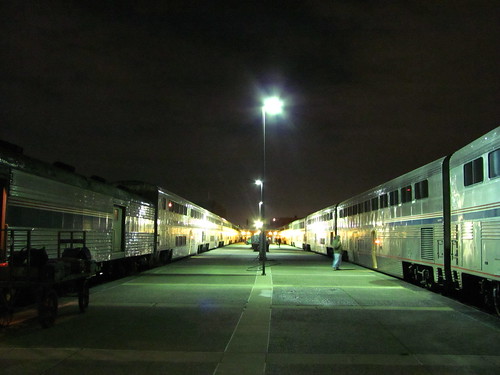
Empire Builders meeting at Spokane, Washington.

My photostream

Monday, November 15, 2010

Monday Shot: Sun Flare

Monday Shot isn't quite espresso, but hopefully this weekly transit picture will help get your week started.

I haven't run a Monday Shot in a while, but I have a lot of new transit pictures, so I might just have to start it up again.

Sun Flare
The sun reflects off of a southbound Link light
rail train at Seattle's Columbia City station.


My photostream

Monday, October 11, 2010

Seattle, here I come

I'll be in Seattle this weekend, mainly to try out the new additions to the transit network: the Link LRT and the South Lake Union Trolley.

If I still have any readers in the area, I would not be opposed to grabbing a cup of coffee. And I'd also appreciate pointers on any must-sees in transit, cycling, or pedestrian design/infrastructure or good urban planning projects.

I have been to Seattle before. In fact, I strongly considered moving there back in 2007, but I ended up in DC instead. It's a great town, and I'm glad to have the opportunity to visit again.

The last time I was there, I missed out on a lot. The Bus Tunnel was closed for conversion to Link, the Monorail was closed because of the collision, and neither Link nor the Trolley were open. And I didn't have time to ride Sounder.

But I plan on taking care of all of those things on this trip. Anything else I should be sure not to miss?

Sunday, March 28, 2010

Highways After People

On Sunday, I had the opportunity to travel to Breezewood, Pennsylvania to bike on a portion of the Abandoned Pennsylvania Turnpike. Check out my photos below.


This stretch of the abandoned turnpike is 13 miles long, and was abandoned in 1968. It includes two tunnels, Rays Hill and Sideling Hill. I had hoped to bike the whole segment, but rain set in, and the trip had to be cut short.

So, the trip only included a ride through the Sideling Hill Tunnel, 1.3 miles of inky darkness.

This section of the Turnpike opened in 1940, and was bypassed in 1968 because it was cheaper than twinning the two tunnels. It's an eerie site. It's out in the middle of nowhere, and seems some remnant of a post-apocalyptic world. The whole time we spent on the old turnpike, we saw only two other people, local teens by the look, emerging from the darkness on foot.

The tunnels actually date back to 1881 and the construction of the South Penn Railroad, which went bust before completion. In the late 1930s, the Pennsylvania Turnpike Commission completed and expanded the tunnels.

However, most of the railroad line follows a different alignment from the Turnpike. In places, you can see traces. Several photos in my set show the railroad grade (and a culvert) just west of the western portal of the Sideling Hill Tunnel.

Tuesday, March 16, 2010

A Trip to Morgantown

I know I've been absent from Track Twenty-Nine for a while, and I apologize. I've been busy of late, and got out of the habit of writing here.

Yesterday, I took a day trip out to Morgantown, West Virginia, home to America's first Personal Rapid Transit (PRT) System. The line was built as a demonstration project, and opened in 1975.


There are about 3 miles of linear dual-track guideway and 5 stations. The system is linear in nature, with all five stations lying along the course of the main guideway. However, the three intermediate stations are set up so that through trains can bypass them.

When the fare is paid, a set of options on the faregate lights up which allows the passenger to select his or her destination. This sends a signal to the computer, which dispatches a vehicle to the station. The stations themselves are pretty simple. End-of-line stations (Walnut, Health Sciences) are the smallest, and are set up as loop stations. Intermediate stations are much larger, and have station tracks, loop tracks, and bypass tracks. They also have more than one platform, for handling different directions of travel.

Each track at a station has 2 or 3 unloading bays and one loading bay. A vehicle arriving discharges passengers before proceeding to the loading bay. There are 8 seats per car and room for 12 standees. The vehicles are capable of running up to 30 mph.

I was impressed with the system. It works well in this campus setting. Some cars were running empty (shuttling to other stops), others had standing passengers. Wait times were fairly short. I never had to wait more than 5 minutes.

In Downtown Morgantown, I didn't find the guideway too intrusive, but there was plenty of other visual clutter on the landscape to distract from it. It helps that it does not run over streets (except for Walnut Street near that station). It crosses several streets, but just briefly. On the campus it is largely at grade.
The intermediate stations do take up significant space. I think they could probably be made much smaller, perhaps on the scale of the end-of-line stations. I also think that a linear automated guideway system like Miami's Metromover could be a decent substitute in other campus settings.

My visit was an interesting experience. I'm glad I had the opportunity to do it. And I would encourage you to stop by if you find yourself in Morgantown. For $0.50 per ride, it's a pretty good deal.

Sunday, August 23, 2009

Track Twenty-Nine: Two Years Old

It's hard to believe that I've been doing this for two years already. Blogging, I mean.

I'm afraid that my second year did not see me achieve my goal of three posts a week, but I feel my content is worth reading and informative. Hopefully, I'll do a better job in my third year of increasing both the quantity and quality of my musings.

A look back on the last year is in order, I suppose.

During my second year in Washington and my second year as a blogger, I've increased the sphere of my writing. I now write a weekly feature for The New Gay, called Newsprints, and a biweekly column for the same publication, known as Dispatches from Left Field. In addition, I've started writing for Greater Greater Washington, with much of that content crossposted here.

In terms of my Washington explorations, my travels on the Metro have added a few stations from last year, but no new territory. I've still never ridden the Red Line north of Rockville or the Green Line south of Southern Avenue. But I've used (entered or exited the faregates) quite a few stations. I only lack two in Montgomery County and four in the District of Columbia. Prince George's County and Virginia are a bit more daunting, but I'm sure I'll get up to 100% one of these days. At the moment, I'm at 68 out of 86, so my batting average is 79%.


Another goal of mine is to ride every rail transit system in America. I'm always gaining and losing ground (because they keep opening new systems). In the last year, I've added a few:

Caltrain,

San Jose LRT,

ACE,

Sacramento LRT,

Minneapolis' Hiawatha Line - which I did not get any pictures of,

The Charlotte Trolley,

Music City Star,

Metro North,

The Long Island Railroad - which I did not get a picture of, and

AirTrain JFK - which I also have not photographed.

I suppose the largest development in the past year was my graduation from graduate school at the University of Maryland. Now, I'm officially an Urban Planner. I've also moved in with my boyfriend of two years, which has been great.

I'm looking forward to another great year at Track Twenty-Nine. But I'd like to know, What would you like to see?

As always, thanks for reading.