Four O'Clock Factoid is a daily feature on Track Twenty-Nine helping to get you through the workday with a bit of useless knowledge.
On October 1, 1964, the first modern high speed rail line in the world opened, Japan's Tokaido Shinkansen. The line, which connects Tokyo to Osaka, a distance of 320 miles, in 2h25. It is the most heavily traveled high-speed rail line in the world, having carried over 4.5 billion passengers since its opening.
Showing posts with label Four O'Clock Factoid. Show all posts
Showing posts with label Four O'Clock Factoid. Show all posts
Friday, February 5, 2010


Thursday, February 4, 2010
Four O'Clock Factoid: Supremely Continental
Four O'Clock Factoid is a daily feature on Track Twenty-Nine helping to get you through the workday with a bit of useless knowledge.
In 1978, when Via Rail Canada took over operations of CN and CP passenger rail services in Canada, they operated two transcontinental routes, the Canadian and the Super Continental. The Super Continental had been Canadian National's transcontinental route, operating on the northern route from Montreal to Vancouver through Edmonton. The Canadian was CP's flagship train, operating over the original transcontinental route through Calgary. It started from both Montreal and Toronto, with the trains being joined (or split, eastbound) at Sudbury for the journey to Vancouver. Over the years, the Canadian became the premiere train on the Via network, and during the cuts of 1990, Via cancelled the Super Continental. The Canadian, along with the stainless steel rolling stock inherited from CP, began traveling over the route of it's former rival, the Super Continental. This arrangement continues today, leaving Calgary the largest Canadian city without Via rail service.
In 1978, when Via Rail Canada took over operations of CN and CP passenger rail services in Canada, they operated two transcontinental routes, the Canadian and the Super Continental. The Super Continental had been Canadian National's transcontinental route, operating on the northern route from Montreal to Vancouver through Edmonton. The Canadian was CP's flagship train, operating over the original transcontinental route through Calgary. It started from both Montreal and Toronto, with the trains being joined (or split, eastbound) at Sudbury for the journey to Vancouver. Over the years, the Canadian became the premiere train on the Via network, and during the cuts of 1990, Via cancelled the Super Continental. The Canadian, along with the stainless steel rolling stock inherited from CP, began traveling over the route of it's former rival, the Super Continental. This arrangement continues today, leaving Calgary the largest Canadian city without Via rail service.
Wednesday, February 3, 2010
Four O'Clock Factoid: Genesis
Four O'Clock Factoid is a daily feature on Track Twenty-Nine helping to get you through the workday with a bit of useless knowledge.
The GE Genesis is currently the workhorse of the Amtrak locomotive fleet. Units are also in use on Via Rail Canada, Metro-North, and NJ Transit. The Genesis locomotives were built between 1992 and 2001 and are more efficient than their predecessor the F40PH, using 22% less fuel and producing 25% more power. The first variant of the locomotive, the P40DC is capable of traveling at 103 mph, while the newer variants, the P42DC and the P32AC-DM can make it up to 110 mph. The P32 is used on routes operating out of New York-Penn Station and on Metro-North (out of Grand Central) because it is also able to pull power from a third rail in tunnels around New York City.
The GE Genesis is currently the workhorse of the Amtrak locomotive fleet. Units are also in use on Via Rail Canada, Metro-North, and NJ Transit. The Genesis locomotives were built between 1992 and 2001 and are more efficient than their predecessor the F40PH, using 22% less fuel and producing 25% more power. The first variant of the locomotive, the P40DC is capable of traveling at 103 mph, while the newer variants, the P42DC and the P32AC-DM can make it up to 110 mph. The P32 is used on routes operating out of New York-Penn Station and on Metro-North (out of Grand Central) because it is also able to pull power from a third rail in tunnels around New York City.
Tuesday, February 2, 2010
Four O'Clock Factoid: Interbau
Four O'Clock Factoid is a daily feature on Track Twenty-Nine helping to get you through the workday with a bit of useless knowledge.
Berlin's Hansaviertel is an example of modernist planning principles. The neighborhood was mostly destroyed during the Second World War and planners sought to recapture the Stadt-Wesen, the city essence, lost during the industrial revolution. The development follows the principles of Le Corbusier and the Athens Charter, and is composed of buildings in a parklike setting. The buildings were designed by many well-known architects and constructed for the 1957 building exhibition Interbau.
Berlin's Hansaviertel is an example of modernist planning principles. The neighborhood was mostly destroyed during the Second World War and planners sought to recapture the Stadt-Wesen, the city essence, lost during the industrial revolution. The development follows the principles of Le Corbusier and the Athens Charter, and is composed of buildings in a parklike setting. The buildings were designed by many well-known architects and constructed for the 1957 building exhibition Interbau.
Monday, February 1, 2010
Four O'Clock Factoid: Deep
Four O'Clock Factoid is a daily feature on Track Twenty-Nine helping to get you through the workday with a bit of useless knowledge.
The world's deepest subway station is Kiev's Arsenalna station. It is located 102 meters (335 feet) below the surface. An escalator ride to the platform takes close to 5 minutes. It opened November 6, 1960.
The world's deepest subway station is Kiev's Arsenalna station. It is located 102 meters (335 feet) below the surface. An escalator ride to the platform takes close to 5 minutes. It opened November 6, 1960.
Friday, January 29, 2010
Four O'Clock Factoid: Nonstop
Four O'Clock Factoid is a daily feature on Track Twenty-Nine helping to get you through the workday with a bit of useless knowledge.
Geisterbahnhöfe (German: Ghost Stations) originally referred to closed subway stations in Berlin, through which trains passed without stopping due to the division of the city by the Berlin Wall. Some U-bahn or S-bahn lines ran for the most part in West Berlin, but passed through the Soviet Sector in the center of the city. Patrons could ride along these lines through East Berlin, but trains did not stop. The Geisterbahnhöfe were dimly lit and patrolled by East German border guards. Trains did stop at Friedrichstraße, which was a transfer point between Western lines and also a border crossing into East Berlin. The Western lines with Ghost Stations were today's U6 and U8 and the Nord-Süd Bahn of the S-bahn.
Here is a 1984 map of the U- and S-bahn networks produced by the Western operator, BVG. Geisterbahnhöfe are labeled as Bahnhöfe auf denen die Züge nicht halten (stations at which trains do not stop). On Eastern U- and S-bahn maps, West Berlin is depicted as having no infrastructure, and the Western lines passing through East Berlin are not shown. Here is an Eastern 1984 map.
Geisterbahnhöfe (German: Ghost Stations) originally referred to closed subway stations in Berlin, through which trains passed without stopping due to the division of the city by the Berlin Wall. Some U-bahn or S-bahn lines ran for the most part in West Berlin, but passed through the Soviet Sector in the center of the city. Patrons could ride along these lines through East Berlin, but trains did not stop. The Geisterbahnhöfe were dimly lit and patrolled by East German border guards. Trains did stop at Friedrichstraße, which was a transfer point between Western lines and also a border crossing into East Berlin. The Western lines with Ghost Stations were today's U6 and U8 and the Nord-Süd Bahn of the S-bahn.
Here is a 1984 map of the U- and S-bahn networks produced by the Western operator, BVG. Geisterbahnhöfe are labeled as Bahnhöfe auf denen die Züge nicht halten (stations at which trains do not stop). On Eastern U- and S-bahn maps, West Berlin is depicted as having no infrastructure, and the Western lines passing through East Berlin are not shown. Here is an Eastern 1984 map.
Thursday, January 28, 2010
Four O'Clock Factoid: The Nearest Doorway to Heaven
Four O'Clock Factoid is a daily feature on Track Twenty-Nine helping to get you through the workday with a bit of useless knowledge.
The Qingzang Railway holds the title of world's highest railroad. It passes through the Tanggula Pass near Wenquan, Tibet, at an elevation of 17,162 feet (5,231 meters) above sea level. The line, which opened in 2006, has the nickname 'the nearest door to the heaven.'
The Qingzang Railway holds the title of world's highest railroad. It passes through the Tanggula Pass near Wenquan, Tibet, at an elevation of 17,162 feet (5,231 meters) above sea level. The line, which opened in 2006, has the nickname 'the nearest door to the heaven.'
Wednesday, January 27, 2010
Four O'Clock Factoid: The Really Fast Mail
Four O'Clock Factoid is a daily feature on Track Twenty-Nine helping to get you through the workday with a bit of useless knowledge.
The Wreck of the Old 97 was a train crash that occurred September 23, 1903. Southern Railway's Fast Mail was a train bound for Spencer, North Carolina. It was already late when it left Washington, and at Monroe, Virginia the engineer was instructed not to be late arriving in Spencer. The typical average speed taken between Monroe and Spencer was 39 mph, but in order to be on time, the train would have to average at least 51 miles per hour. At Danville, Virginia, the train left the tracks on the trestle over Cherrystone Creek, traveling at over 50 mph. Nine people were killed in the wreck, which inspired a well-known ballad of the same name.
The Wreck of the Old 97 was a train crash that occurred September 23, 1903. Southern Railway's Fast Mail was a train bound for Spencer, North Carolina. It was already late when it left Washington, and at Monroe, Virginia the engineer was instructed not to be late arriving in Spencer. The typical average speed taken between Monroe and Spencer was 39 mph, but in order to be on time, the train would have to average at least 51 miles per hour. At Danville, Virginia, the train left the tracks on the trestle over Cherrystone Creek, traveling at over 50 mph. Nine people were killed in the wreck, which inspired a well-known ballad of the same name.
Tuesday, January 26, 2010
Four O'Clock Factoid: Precursor
Four O'Clock Factoid is a daily feature on Track Twenty-Nine helping to get you through the workday with a bit of useless knowledge.
Levittown, New York was the first mass-produced, planned suburb of the post-war era. It is largely considered to have set the archetype for most suburban development in the United States from the 1940s on. The first Levittown was on Long Island, but others were built in New Jersey, Pennsylvania, and Puerto Rico.
Levittown, New York was the first mass-produced, planned suburb of the post-war era. It is largely considered to have set the archetype for most suburban development in the United States from the 1940s on. The first Levittown was on Long Island, but others were built in New Jersey, Pennsylvania, and Puerto Rico.
Monday, January 25, 2010
Four O'Clock Factoid: Spanish Solution
Four O'Clock Factoid is a daily feature on Track Twenty-Nine helping to get you through the workday with a bit of useless knowledge.
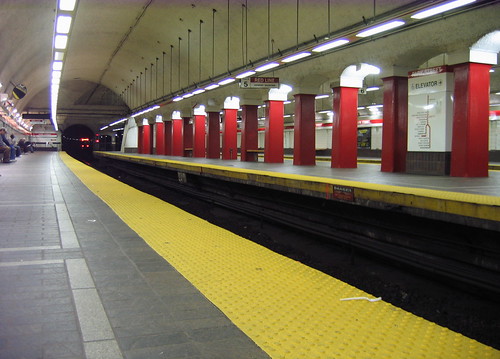 The term Spanish Solution refers to a transit station design principle whereupon platforms are located on both sides of a track. This is used at high-volume stations to make it easier for patrons to board and alight. Sometimes one platform is reserved for boarding and the other for alighting, in other instances either platform can be used for either purpose. Examples include Atlanta's Five Points station, Munich's Marienplatz (S-bahn), and Charles de Gaulle - Etoile on Line 6 in Paris. It takes its name from early implementation on Barcelona's Metro, although the earliest instance occurred at Park Street Under (Red Line) in Boston in 1912.
The term Spanish Solution refers to a transit station design principle whereupon platforms are located on both sides of a track. This is used at high-volume stations to make it easier for patrons to board and alight. Sometimes one platform is reserved for boarding and the other for alighting, in other instances either platform can be used for either purpose. Examples include Atlanta's Five Points station, Munich's Marienplatz (S-bahn), and Charles de Gaulle - Etoile on Line 6 in Paris. It takes its name from early implementation on Barcelona's Metro, although the earliest instance occurred at Park Street Under (Red Line) in Boston in 1912.
Friday, January 22, 2010
Four O'Clock Factoid: Bulwark becomes Boulevard
Four O'Clock Factoid is a daily feature on Track Twenty-Nine helping to get you through the workday with a bit of useless knowledge.
Baron Georges-Eugène Haussmann is largely credited with creating the modern Paris. His plan of avenues created large open spaces by cutting through the medieval city. Planning and construction of the Haussmann proposal occurred in the mid-1800s under Napoleon III. It was Haussmann's plan that brought the word "Boulevard" into common usage and which also contributed strongly to the City Beautiful Movement.
Baron Georges-Eugène Haussmann is largely credited with creating the modern Paris. His plan of avenues created large open spaces by cutting through the medieval city. Planning and construction of the Haussmann proposal occurred in the mid-1800s under Napoleon III. It was Haussmann's plan that brought the word "Boulevard" into common usage and which also contributed strongly to the City Beautiful Movement.
Thursday, January 21, 2010
Four O'Clock: Nationalizing
Four O'Clock Factoid is a daily feature on Track Twenty-Nine helping to get you through the workday with a bit of useless knowledge.
Railpax was the intended brand name for the National Railroad Passenger Corporation. At the last minute, the name was changed to Amtrak. The NRPC was formed in 1970 and service began in May 1971.
Railpax was the intended brand name for the National Railroad Passenger Corporation. At the last minute, the name was changed to Amtrak. The NRPC was formed in 1970 and service began in May 1971.
Wednesday, January 20, 2010
Four O'Clock Factoid: Dense Stop Spacing
Four O'Clock Factoid is a daily feature on Track Twenty-Nine helping to get you through the workday with a bit of useless knowledge.
Paris has one of the highest densities of transit stations anywhere. In the 41 square mile city, there are 245 Metro stations - roughly one for every 0.17 (one-fifth) of a mile. And that figure doesn't count the RER stations also in the city limits.
Paris has one of the highest densities of transit stations anywhere. In the 41 square mile city, there are 245 Metro stations - roughly one for every 0.17 (one-fifth) of a mile. And that figure doesn't count the RER stations also in the city limits.
Tuesday, January 19, 2010
Four O'Clock Factoid: Christmas Present
Four O'Clock Factoid is a daily feature on Track Twenty-Nine helping to get you through the workday with a bit of useless knowledge.
Savannah, Georgia was the original capital of the colony and, later, the state of Georgia. It is an early example of town planning in the United States, with a rectilinear street grid intersecting a set of squares. The squares had space reserved for public and religious buildings on their edges. In December 1864, after capturing the city in his March to the Sea, General William Sherman gave Savannah to President Lincoln as a 'Christmas present.'
Savannah, Georgia was the original capital of the colony and, later, the state of Georgia. It is an early example of town planning in the United States, with a rectilinear street grid intersecting a set of squares. The squares had space reserved for public and religious buildings on their edges. In December 1864, after capturing the city in his March to the Sea, General William Sherman gave Savannah to President Lincoln as a 'Christmas present.'
Monday, January 18, 2010
Four O'Clock Factoid: Omni-modal
Four O'Clock Factoid is a daily feature on Track Twenty-Nine helping to get you through the workday with a bit of useless knowledge.
Vancouver's Waterfront Station is a major intermodal hub. Initially built by the Canadian Pacific Railway, the downtown station now links just about all of the transportation modes serving Vancouver. While inter-city trains no longer call at Waterfront, all three of Vancouver's SkyTrain services stop there. In addition, a helipad, cruise ship terminal, and the SeaBus pier are all connected to the station. The terminal for float planes is very near.
Vancouver's Waterfront Station is a major intermodal hub. Initially built by the Canadian Pacific Railway, the downtown station now links just about all of the transportation modes serving Vancouver. While inter-city trains no longer call at Waterfront, all three of Vancouver's SkyTrain services stop there. In addition, a helipad, cruise ship terminal, and the SeaBus pier are all connected to the station. The terminal for float planes is very near.
Friday, January 15, 2010
Four O'Clock Factoid: Key to the System
Four O'Clock Factoid is a daily feature on Track Twenty-Nine helping to get you through the workday with a bit of useless knowledge.
When opened in 1936, the San Francisco-Oakland Bay Bridge was designed to carry interurban and light rail-type traffic, although trains did not come to the bridge until 1938. The lower deck of the bridge carried three lanes of traffic and two rail tracks; the upper deck carried six lanes of traffic. On the peninsula side, the Transbay Terminal was constructed for interurban and trolley traffic. Trains left the bridge on a looping viaduct which carried them above the streets of San Francisco into the terminal. When rails were removed from the bridge in 1958 in order to create two more lanes for cars, the Transbay Terminal and approach viaducts were reconfigured as a bus terminal - still in use today.
When opened in 1936, the San Francisco-Oakland Bay Bridge was designed to carry interurban and light rail-type traffic, although trains did not come to the bridge until 1938. The lower deck of the bridge carried three lanes of traffic and two rail tracks; the upper deck carried six lanes of traffic. On the peninsula side, the Transbay Terminal was constructed for interurban and trolley traffic. Trains left the bridge on a looping viaduct which carried them above the streets of San Francisco into the terminal. When rails were removed from the bridge in 1958 in order to create two more lanes for cars, the Transbay Terminal and approach viaducts were reconfigured as a bus terminal - still in use today.
Thursday, January 14, 2010
Four O'Clock Factoid: The West Wind
Four O'Clock Factoid is a daily feature on Track Twenty-Nine helping to get you through the workday with a bit of useless knowledge.
The Rio Grande Zephyr was a well-known passenger train operated by the Denver and Rio Grande Western before and after the formation of Amtrak. The Zephyr was one of only a few trains not taken over by Amtrak in 1971. It was a descendant of the California Zephyr, which operated from Chicago to Oakland over several railroads. Because the D&RGW elected to opt out of Amtrak, the California Zephyr ceased to exist, with Amtrak operating The City of San Francisco from Chicago to Oakland via Cheyenne and Ogden, while passengers could connect to the Rio Grande Zephyr at Denver and Ogden. In 1983, D&RGW turned the Zephyr over to Amtrak, which renamed the route the California Zephyr, and discontinued use of the route through Ogden.
The Rio Grande Zephyr was a well-known passenger train operated by the Denver and Rio Grande Western before and after the formation of Amtrak. The Zephyr was one of only a few trains not taken over by Amtrak in 1971. It was a descendant of the California Zephyr, which operated from Chicago to Oakland over several railroads. Because the D&RGW elected to opt out of Amtrak, the California Zephyr ceased to exist, with Amtrak operating The City of San Francisco from Chicago to Oakland via Cheyenne and Ogden, while passengers could connect to the Rio Grande Zephyr at Denver and Ogden. In 1983, D&RGW turned the Zephyr over to Amtrak, which renamed the route the California Zephyr, and discontinued use of the route through Ogden.
Wednesday, January 13, 2010
Four O'Clock Factoid: Chasing History
Four O'Clock Factoid is a daily feature on Track Twenty-Nine helping to get you through the workday with a bit of useless knowledge.
The Western and Atlantic Railroad is a rail line linking Atlanta, Georgia and Chattanooga, Tennessee. It is and has always been owned by the state of Georgia. It was chartered by the state to link the Chattahoochee and Tennessee Rivers and was the primary factor in Atlanta's rise as a transportation hub. It is famous for the "Great Locomotive Chase" which took place on April 12, 1862, when Union troops seized the locomotive General and attempted to burn bridges on the line to cut Confederate supply lines.
The Western and Atlantic Railroad is a rail line linking Atlanta, Georgia and Chattanooga, Tennessee. It is and has always been owned by the state of Georgia. It was chartered by the state to link the Chattahoochee and Tennessee Rivers and was the primary factor in Atlanta's rise as a transportation hub. It is famous for the "Great Locomotive Chase" which took place on April 12, 1862, when Union troops seized the locomotive General and attempted to burn bridges on the line to cut Confederate supply lines.
Tuesday, January 12, 2010
Four O'Clock Factoid: See the Water for the Park
Four O'Clock Factoid is a daily feature on Track Twenty-Nine helping to get you through the workday with a bit of useless knowledge.
Tom McCall Waterfront Park is a park in Portland, Oregon named after a former governor. The park replaced Harbor Drive, the construction of which in 1940 cut downtown off from the Willamette River. Governor McCall set in motion the removal of the freeway and the creation of a park in its stead.
Monday, January 11, 2010
Four O'Clock Factoid: 'State' of the Art
Four O'Clock Factoid is a daily feature on Track Twenty-Nine helping to get you through the workday with a bit of useless knowledge.
The State Street Subway in Chicago is home to the world's longest subway station. The island platform actually stretches continuously through four stations: Lake, Washington, Monroe, and Jackson. The platform is 3,500 feet in length. While labeled as four separate stations, it is essentially one long station with four stopping points.
Subscribe to:
Posts (Atom)


