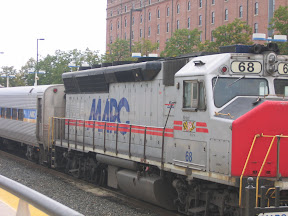
Despite rising ridership on Maryland's MARC train, MTA is proposing service cuts, beginning before year's end. MARC is a commuter and regional rail service operating between Washington and Baltimore, with limited service north of Baltimore, and between Washington, Frederick, and Martinsburg, WV.
of MARC service, including weekend service on the Penn Line and midday service on the Camden Line. Governor Martin O'Malley had named MARC expansion one of his top priorities and the ambitious MARC Expansion Plan called for a tripling of MARC Service by 2035.
With high gas prices, MARC ridership was way up. Many trains are standing room only leaving Washington Terminal, including some trains that still have standing passengers when they arrive in Baltimore.
But the slowing economy has led to decreased revenues. The governor has ordered across-the-board cuts, and MTA is not exempt. In addition to reductions in service on commuter bus lines, MARC will be taking a hit too. The proposed cuts are listed below. They will go into effect on January 12, 2009 except for holiday service cuts, which will go into effect sooner.
These cuts are part of a phenomenon being seen across the nation. They are indicative of a transportation funding mechanism which is broken. Although Maryland claims to be a smart growth state, cuts to transit are affecting thousands of commuters, while construction continues to progress on the sprawl-inducing Intercounty Connector (ICC). These cuts come at a time when we are trying to reduce our dependence on foreign oil and when we are trying to reduce the climate impacts of our auto-centric society.
The state is between a rock and a hard place, and I certainly understand the need to cut spending. However, these cuts will take Maryland in the wrong direction. America's transportation infrastructure is decaying, transit ridership is up, and smart growth continues to blossom. Now is not the time for cuts to MARC service.
Please write to MTA and your local legislator and governor O'Malley to object to these cuts. A letter to the presidential candidates wouldn't hurt either. Next year may prove to be a watershed year for transportation investment--or the year we let it all go down the tubes. If the economy is issue number 1, transportation is issue number 2. It influences our environmental, energy, urban, and foreign policies and we cannot afford not investing in it any longer.
Hearings are being held throughout the region on the proposed MARC cuts. The schedule is available here.
Comments regarding these cuts may be made to MTA:
By Mail:
Mr. Glenn Litsinger
MTA Office of Customer Information
6 St. Paul Street
Baltimore, MD 21202
By Email:
marc@mtamaryland.com
“Hearing Comments” as subject
ALL COMMENTS MUST BE RECEIVED BY 5PM, MONDAY, DEC. 26
Currently proposed for elimination:
Evening Service: Penn Line trains 445, 446, 447, & 448
This cut will eliminate two round trips from Washington to Baltimore. Currently, the last train leaves Washington for Balto. at 11p, arriving at Penn Station at 11:59p. The last train leaving Baltimore for Union Station is at 9:30p, arriving at 10:35p. With the cuts, the last Baltimore-bound MARC train will leave DC at 8:40p and get into Baltimore at 9:36p. It will continue on to Perryville. After the cuts, the last MARC train bound for Washington will depart Baltimore at 7:25p and arrive in Washington an hour later.
Brunswick Line Service: Train 871 eliminated Mon-Thur
The proposed cuts will eliminate the first departure from Washington on the Brunswick Line Mondays through Thursdays. The existing 1:45p departure will remain on Fridays, but on the other four days of the week, the first train to go to Brunswick will depart at 3:35p.
West Virginia Service: Cutback of Train 883 to Brunswick
The cuts will also reduce service at MARC's three West Virginia Stations to 2 outbound trains. The last Brunswick line departure will remain 7:15p, but Train 883 will stop at Brunswick. Passengers headed to Harpers Ferry, Duffields, and Martinsburg will have to catch the 5:35p departure of Train 879 in order to get home.
Elimination of Holiday Service:
While MARC already doesn't operate on Martin Luther King Day, President's Day, Memorial Day, Independence Day, Labor Day, Thanksgiving, Christmas, and New Year's Day. MTA also proposes to eliminate service on Columbus Day, Veterans' Day, the day after Thanksgiving, and December 26.
Reduction of Winter "Holiday" Service:
On December 24th, January 2, and the period from December 27 to December 31, MARC will operate only holiday service. Currently, trains operate on a full schedule on these days.
Laurel Bus Connection: Elimnation of Odenton Shuttle
The cuts will eliminate the shuttle bus which operates from Odenton to Laurel completely. This is a far cry from the proposed implementation of midday service on the Camden Line. This bus currently represents the only way to use MARC to get to the Laurel area between rush hours.
Several weeks ago I started a new section of this blog, dedicated to proposing potential futures for transit here in DC, and potentially elsewhere. While this activity is largely an exercise in fantasy, it can also be used as a tool for envisioning a future with a greater emphasis on transit. After hearing comments from readers in regards to my " Regional Rail Plan,"I have decided to make some changes. For the sake of brevity, I will try not to repeat myself. For more information on the constraints facing commuter rail at present, see my first post in this series: Make No Little Plans I. For the earlier iteration of this plan, see: Make No Little Plans II. And finally, for my initial response to commentary on these issues, see: RLS Kicking In. I'll also take this opportunity to remind my readers of others like me who have been indulging in a similar exercise in imagining a Baltimore-Washington future full of transit: And without further ado, here's my revised regional rail plan. Remember, this plan only deals with the commuter/regional rail element of Washington's transit future. I will be releasing the metro (heavy) rail and light rail elements soon--perhaps later this week.  New to the Plan: New to the Plan:
I decided to reconsider the omission of a direct connection between Annapolis and Baltimore. In that regard, I added the line M7, which will operate from a shared terminal at Annapolis-Washington Street with the line M2 (Farragut Square-Annapolis). There are some difficulties, however, with getting a train between Baltimore and Annapolis these days. It was for this reason that I left this route out of the original plan. These difficulties are elaborated below as I describe alternative alignments for the M7 line. There are three corridors which I judged to be able to be used for a train line. Each has its own problems and advantages, and based on these I have selected what I think is the most feasible alignment. Alternative 1:The first alignment I considered would connect Baltimore and Annapolis by running trains south on the Northeast Corridor from Penn Station (or Camden Station using the M1 connection) as far as Bowie State. Just south of the existing MARC Station, the line would follow the CSX line ( Pope's Creek Secondary) which runs through Upper Marlboro and Waldorf on its way to the PEPCO generating plant at Morgantown. At Route 50, the line would merge with the proposed M2 Line running from Farragut to Annapolis. The main advantage of this routing is that it uses existing rights-of-way for its entire trip. It follows the Northeast Corridor, the Pope's Creek Secondary, Route 50, and the abandoned interurban tracks from Annapolis Mall to Washington Street. Unfortunately this route, while perhaps the most financially and politically palatable is the least attractive to commuters. It is a trip of over 40 miles from Washington Street to Penn Station. The same distance by car is under 30 miles (via Ritchie Highway). Alternative 2:In order to shorten that distance, the same route could be used between Baltimore and Odenton, with the route operating along with M1 or M3 trains. From Odenton to Annapolis, the line would follow the abandoned track of the Annapolis and Elk Ridge Railroad to Annapolis Mall and on to Washington Street. While this alignment shaves more than 11 miles off of Alternative 1, it has its own drawbacks. Much of the route is directly adjacent to Generals Highway, making it undesirable from a speed and NIMBY perspective, although in this case it would be more of a front yard objection. Additionally, Annapolis Mall was built in the right-of-way, so trains would have to curve around it. Alternative 3:
I think this alternative is the most promising, and it is the one I included in my map. Alternative 3 would follow the disused right-of-way of the defunct Baltimore and Annapolis Railroad. Much of the line's right-of-way is preserved. The route of Alternative 3 is parallel to Ritchie Highway for most of its length. Freight operated on the line until the 1980s, although now the much of the path has been turned into the Baltimore and Annapolis Trail. From the terminal at Annapolis Washington Street, it will cross the Severn River south of the existing Route 50 overcrossing, after passing adjacent to the Naval Academy's stadium. The bridge used by the interurban to cross the Severn is no longer present, and a replacement will need to be constructed. The main obstacle, however, to Alternative 3 is the Baltimore Light Rail. The B&A right of way was used to construct the line from Downtown to Glen Burnie. It is possible, although would likely be extremely difficult, to squeeze a third track into the LRT cross-section between Glen Burnie and Linthicum. North of Linthicum, the right of way is slightly wider, and could accommodate commuter rail more easily. The easiest alternative to the Glen Burnie section would bypass the town alongside Route 100 and would skirt BWI along Aviation Boulevard. Regardless of the exact alternative above, I think a direct Baltimore-Annapolis connection is needed. I have chosen, for my plan, to fit the M7 into the LRT alignment at Glen Burnie. It is the most direct route and has the added benefit of serving the center of Glen Burnie. Revisions:
Extension of the M4 (Camden Route)
Based on comments made on my previous plan, I have decided to defer to the Baltimorians among us and add service to Charles Village as per MTA's plan. The M1, however, will continue to go to Penn Station. Some Camden trains will use the Howard Street Tunnel to continue to Charles Village, Clifton Park, and Martin State Airport. And, I want to thank Batman for pointing out that the Howard Street Tunnel is currently single tracked to allow higher freight cars to pass through. My proposal would require two tracks. Since passenger equipment is shorter than freight equipment, there should be no clearance issues. Technically speaking, there would be no issues with also operating M6 (Baltimore-Frederick) and M7 (Baltimore-Annapolis) to either Penn or Martin State Airport Stations, but I have chosen to terminate them at Camden Station on my maps to eliminate clutter and to preserve space in the tunnel for M1 trains. New WMATA [L] LogosI have also included on the map white 'L's in brown boxes. These logos denote the light rail connections provided in my forthcoming Metro/LRT plan. Oh, and I also added a new "Track Twenty-Nine" logo to the map. I'd love to hear your comments. My last plan has been this site's most popular post. Let's keep the dialog going.
 So for the last week or so, I've been bogged down with all sorts of work, and I haven't been able to continue blogging. I have often heard this referred to as "Real Life Syndrome" (RLS). It certainly feels like a syndrome to me. And unlike the pharmaceutical marketing ploy with the same initials, this RLS actually does disrupt your blog. (Just kidding). Anyway, I wanted to take this time to respond to comments left regarding my last post and to ensure everyone that, yes, I am still working on getting the rest of my transit plan out there.
Alex B.:
2/28/2008/16:19
Interesting ideas.
The downtown tunnel idea is interesting, but I'm not sure it's the best use of resources. I'd be more inclined to create the New Blue line for Metro through this part of downtown, offering another connection at Union Station, giving passengers there two lines to access the core of downtown with. I realize that's not part of your scope here, but I think that would be a far more useful investment for the rest of the city, beyond just regional commuters.
Great job, though. Any ideas on how (or even if) to relocate the L'Enfant tracks, as per the NCPC's plan? I've always had in the back of my mind the crazy idea of re-routing all freight traffic outside of the District somehow, and building a new 'South Station' above the air rights on 395, which could then connect up to the existing 1st street tunnel. This would allow Maryland and Virginia Aves to be rebuilt and piece some of that area back together. Also, having a station there means some trains from MD could bypass Union Station by using the current single track tunnel under the SE Freeway to get to the new L'Enfant station.
Just an idea of mine. Great stuff. I agree. Building a regional rail subway though downtown would not be cheap. It certainly should not come at the expense of the M Street Subway either. In my opinion building a subway to relieve chronic overcrowding in the Blue/Orange subway should be one of the region's highest priorities. But a regional rail subway serves a different purpose. It would make somewhat of a dent in getting Maryland commuters off of the busy Red Line, and could encourage more riders to ride. It worked in Philadelphia and I think it fits here as well. As for the Virginia and Maryland Avenue tracks near L'Enfant Plaza, I think that they must remain in passenger service, if nothing else. There is no other direct route for passenger trains to use from Alexandria to Union Station, and service to L'Enfant is vital to our region. Freight service, on the other hand, is less desirable in the corridor. I don't see an easy way to relocate the tracks, however. Improvements will need to be made, as this corridor is an increasingly busy freight corridor through the Northeast. Josh:
2/28/2008/17:01
Love the plan. On the Baltimore end, though, why not continue along the old Baltimore Belt Line base Mt. Royal? Instead of joining up with the NE Corridor, this would give stops in southern Charles Village (at 25th St.) and Cold Spring before ultimately joining back with the NE Corridor in East Baltimore. I believe MARC actually has such an idea in its long-range plan. You are correct. The MTA has plans to use the Baltimore Belt-Line right-of-way to connect the Mount Royal Tunnel. I felt, however, that a connection between the regional rail line M1 at Penn Station was important to link commuters coming from the Perryville/Wilmington corridor to downtown Baltimore. Remember, I'm proposing bi-directional service of 15-30 minutes, which is better than light rail service is at present. A station at the Baltimore Belt-Line Railway and Charles Street is only 8 tenths of a mile north of Penn Station, approximately 15 minutes walking. While it would be great to serve Charles Village, I think it is outweighed by making a transfer available at Penn Station. I am glad you commented though. This is the kind of feedback that I like. On a side note, at one point I considered running the M1 up Charles Street/York Road in subway to Towson. I think a light or heavy rail extension would do more justice to the corridor though. Amschloss:2/29/2008/13:07
I'm pretty sure that MARC already has plans to extend Penn Line service up to Wilmington. Don't have a link handy, sorry. You are correct--sort of. I linked the document in the post " Make No Little Plans I", which I posted a day prior to this one. MTA's plans only call for an extension to Newark, Delaware, where passengers could connect to Philadelphia's SEPTA regional rail service. The link, if you want to see it, is: http://mtamaryland.com/projects/marc%20plan%20full.pdfGregory:
3/4/2008/12:47
One thing I think you missed is regional rail service to Loudon County. (e.g. Leesburg and beyond) Interesting idea. I would be glad to hear suggestions about getting to Leesburg, though. Unfortunately, one of the most difficult parts of transportation planning is figuring out how to penetrate the urban core. With commuter/regional rail, usually existing train tracks are used. There are none in this case. I suppose one could use the W&OD right-of-way, which is currently a biking/walking facility. However, the Silver Line will be making stops as far as Route 772 (Ryan Road) in a few years if the FTA decides to fund it. If they don't fund the Silver Line, I doubt they'll fund regional rail out there. Anonymous: (from Make No Little Plans I) The issue is not one of safety, but clearance. The freight railroads that own both of VRE's lines and the MARC Camden and Brunswick Lines require low platforms because freight cars are wider than passenger cars. You'll note that the only high platform stations on these all four of these routes are at Greenbelt and Camden Yards. Greenbelt has two "loop" tracks for passenger service only, meaning that at Greenbelt MARC Station, there are four tracks and freight trains never use those adjacent to the platforms. Camden Yards Station is off of the CSX main line, because it is north of the point where the freight trains dive into the Howard Street Tunnel. So, as long as commuter trains operate on freight tracks (as opposed to separate ones alongside), we'll have to deal with the low-platform issue. The alternative would be to build stations like Greenbelt at every location, but that is infeasible in a lot of places with space constraints, like Downtown Manassas. All of you, thanks for the input! I'd love to have more comments. Stay tuned for the rest of my transit plan, due out as soon as I can get it.
Yesterday I prefaced the introduction of my transit plan for the Washington region with a discussion of issues facing commuter rail in the area. In the face of these issues, I have formulated a potential system expansion plan. Below I will elaborate on the different aspects of my plan.
I will note once more, however, that this plan is constrained by a sense of feasibility and political palatability. At the same time, it is clearly beyond the current resources of the region. Yet, in my opinion, it represents a possible and desired outcome which could be achieved. I chose the segments of the rail system based on today’s circumstances and tomorrow’s potential. That is to say that I limited my proposal to what could be supported today rather than what will be needed two decades from now. My Plan Under my plan, I make no assumptions about operating agencies, but I do propose that a unified system will be created with cross-system fares and a common naming/numbering system. The system’s main function is to bring commuters into the central business districts in both Washington and Baltimore. The system also has a major role in linking the cities themselves. Additionally, service to Annapolis will give Marylanders rail access to their government. For the most part, existing services are not drastically changed. I’ve done away with the names for the existing lines because with overlapping routes, it is clearer to define routes in the same fashion as Philadelphia’s regional rail system. At the same time, I will use the present-day names to define particular sections of track—not routes. 
New Regional Services In order to maximize capacity and destinations two new SEPTA-like regional lines will be created. I have dubbed these services M1 (to Baltimore) and M2 (to Annapolis). These trains would use new rolling stock, perhaps similar to the Silverliners used in Philadelphia. Trains would operate at relatively high frequencies in both directions throughout the day. Peak headways would be at a minimum of 15 minutes, with off-peak trains coming at least every 30 minutes. High service levels would make travel between Washington, Annapolis, and Baltimore as easy as travel along existing Metro lines. Regional Rail Subway
To reduce demand on Washington’s Red Line subway, I propose a two-track subway be constructed from Union Station to Farragut Square. An article in the Washington Post last year reported that the most common trips in the Metro system take place between Union Station and the other downtown Red Line stations. A commuter rail subway would alleviate overcrowding and reduce travel time for commuter rail customers. Connections exist to the Washington Metro at Archives, Metro Center, and Farragut Square.  Washington-Baltimore
North of Union Station, both Regional Rail Tunnel services operate along the Northeast Corridor to New Carrollton, where M2 services to Annapolis split off. Lines M1 and M2 travel together to BWI, their last common station. Some improvements would probably be needed along the corridor, including new platforms (high-level) and additional tracks. This section of America’s busiest passenger rail line is currently only 3 tracks. In order to increase service, at least on additional track will probably be needed. At the Camden Line overcrossing, M1 services curve to the northeast to run with M4 services into Camden Station. Along the Penn Line, M3 services continue toward Penn Station, using improved tunnels. These tunnels are a major bottleneck on the Northeast Corridor, and are in need of replacement. As part of that project, an infill station would be constructed at Upton, where connections can be made to the Baltimore Metro. Along the Camden Line, additional tracks could be constructed as needed to allow for additional commuter services. North of the Penn Line crossing, new tracks would need to be constructed to accommodate increased passenger service on the M1 routes which would join and run concurrently into Baltimore. Howard Street Tunnel
In Baltimore, freight trains travel north through the city under Howard Street in a century-old tunnel. A new freight tunnel is long overdue, and once cargo can be moved to a new tunnel, the Howard Street Tunnel will be available for passenger service. My proposal calls for the establishment of frequent regional rail service through the tunnel. At Camden Station, new high-level platforms could be constructed under the existing light rail station. Further north, a new subway station for commuter trains would be constructed at Lexington Market, for convenient transfer to both MTA Metro and Light Rail. At the northern end of the tunnel, trains would serve a reopened Mount Royal Station. Trains on the M1 route would then use new tracks to reach Penn Station before continuing along the Northeast Corridor to a new station at North Broadway and along a spur route to Johns Hopkins Bayview. Washington-Annapolis
In order to connect Washington and Annapolis, a new rail line will be built alongside Route 50 as far as Annapolis Mall. At Route 450, the line would follow the route of an abandoned rail line as far as Washington Street. The line would be electrified and would use the same rolling stock as the M1 line. A New Concourse
Services operating along the Virginia Lines (V1, V2) still remain mainly commuter-based. Some reverse commute trains are operated, but the population and job density south of Alexandria does not warrant the intensive services that would be operated along the Washington-Baltimore-Annapolis routes. In order to free up space on Union Station’s lower level for Maryland run-through service, I propose a new concourse be constructed under Columbus Circle. This subterranean terminal could have several stub-end tracks for Virginia trains. Over the River
The Maryland services not using the Regional Rail Tunnel would either terminate at Union Station or continue south toward Alexandria. The number of trains using the First Street Tunnel would be based on capacity, however all Penn Line (M3) services would continue to Alexandria. Many peak-period trains on the M4 and M5 lines would continue to Alexandria, but some would stop at the present MARC terminal at Union Station. While the Regional Rail Terminal allows commuter services to access the major office district downtown, but run-through service through the First Street Tunnel gives similar access to the major job centers at L’Enfant Plaza, Crystal City, and Alexandria. Between Union Station and Alexandria, several capital improvements are needed. I propose a double-decked version of the First Street Tunnel, with lower level tracks leading into the South Concourse platforms. The upper level would accommodate trains operating into the existing lower level. Additionally, a new tunnel would support turnouts for the Regional Rail Tunnel if separate platforms cannot be constructed at Union Station. From the First Street Tunnel to Alexandria, two dedicated tracks would be constructed for passenger use only. The minimum total width of the railroad right-of-way south of the Tunnel would be four tracks. This widening project would require a new span adjacent to the Long Bridge over the Potomac. Along the way, new island platforms would be constructed at L’Enfant Plaza and Crystal City. At Alexandria, freight bypass tracks would be constructed and a new pedestrian tunnel would directly linking the commuter platforms with the King Street Metro concourse. South of Alexandria commuter and regional trains can access a storage facility to be constructed near the existing Metro Alexandria yard. This storage yard will relieve the overburdened Ivy City Yard near Union Station. Existing Routes and Expansion
In addition to the new routes operating to through the Regional Rail Tunnel, I propose a series of improvements to existing routes. I have already talked about the routings of M3 and M4 (Penn and Camden Lines). In my plan, these services would see an increase in frequencies, although for the M3, that is mainly in the form of limited stop and express service since the M1 will dramatically decrease headways. In addition, infill stations will be constructed on the Penn Line at Severn, Upton, North Broadway, and Chase. The Camden Line will see one extra station at Lansdowne, in southern Baltimore. As is the current practice, some M3 trains (one-half to one-third) continue north of Penn Station. My plan calls for a further expansion of the Penn Line, by extending it north of Perryville. Trains would operate to Wilmington, Deleware, where a connection could be made to Philadelphia’s regional rail system. Trains operating to Martinsburg on the M5 will be extended to Hagerstown under my plan. The M5 and M55 (spur to Frederick) remain mainly commuter lines, but some bi-directional service would provide access to the job centers in Frederick and Hagerstown. In Virginia, a short extension of the Fredericksburg Line (V1) to Crossroads is a cheap and easy expansion already being eyed by VRE. I don’t feel that the market exists at present to extend the commuter line to Richmond. Track capacity expansion in Northern Virginia, however, may allow for increased inter-city Amtrak service to Richmond and the Hampton Roads areas. Virginia’s other line, the V2 to Manassas, would be extended to Haymarket and Remington, another expansion being considered by VRE. The Old Line
I also propose connecting Frederick and Baltimore with limited bi-directional commuter service along CSX’s Old Main Line Subdivision. This rail line would have several stops along the line that marked the beginning of railroading in America. The Future I’d love to hear what you think about my plans. I hope that Track Twenty-Nine can become a forum for discussions like this. As I mentioned before, further plans are forthcoming, but this is my first blush attempt at a regional rail plan. One of the elements that leaves a bit to be desired, though, is a name. I haven’t come up with a catchy name for this proposal yet, but I suppose it’s not absolutely necessary to do so. As far as I’m concerned, this plan is achievable without changing the organizational structure of the region’s commuter rail system. Whether my proposal proves feasible or otherwise, I have achieved my goal: to contribute to the discussion. I've done my part. Now it's time for you to do yours. So tell me what you think (and tell your elected representatives too).
 With an ever-increasing growth in transit ridership in our national capital, it is time to consider the future of transportation in Washington. Over the past few weeks several bloggers have introduced transit plans for the region, and I have decided to put mine out there too. In order to put my proposal in context, I should qualify my candidate projects. It is tempting to assume unlimited funds and total political palatability for transit projects when making fictional transit plan. At the same time, I also wanted to create a plan (or elements thereof) that have a feasible chance of being constructed. And while the strength of any plan like this is its uniqueness, it is often difficult find ideas that are not merely a rehashing of other plans. Yet there is value in showing a potential future. An organization which I was affiliated with in Atlanta uses a similar map to build support for transit funding, and there is much to be said for showing people what we could do with dedicated funding and a little will power. My plan for the Washington region will be shown in parts, mostly because I’m still finishing up on sections of it. While I’ve been working on the plan for a while, school work and work work have kept me too busy to complete it. The first part of my plan to be posted here on Track Twenty-Nine is the regional and commuter rail plan. I’m releasing it first simply because it was the first section of my plan to be completed and it represents one of the modes with the greatest potential and some of the greatest limitations. Before I do so, however, it is necessary to lay some groundwork. After I set out to write a post describing my proposal for a regional/commuter rail system, I realized that the post was too long. So I divided it. This post talks about what we have, ideas for the future, and obstacles to their achievement. The next post will outline my plan. Ideally, these posts would be taken as a unit, but I think they will also stand alone quite well. Existing System Washington is currently home to two commuter rail systems. The older is Maryland’s MARC service. This service has been expanded over the years, but dates back to operation by the Baltimore & Ohio and Pennsylvania Railroads. MARC is operated by the state of Maryland’s Mass Transit Administration, which also operates Baltimore’s light rail and metro lines. Service operates from Washington’s Union Station to Baltimore on the Penn and Camden Lines and to Frederick and Martinsburg, West Virginia on the Brunswick Line. Additionally, the Penn Line serves several communities north of Baltimore in Harford and Cecil Counties. Northern Virginia is served by Virginia Railway Express. Service on VRE dates back to 1992. Trains operate from Union Station to Manassas and Fredericksburg via Alexandria. Virginia’s commuter rail service is operated as a partnership between the Northern Virginia Transportation Commission and the Potomac and Rappahannock Transportation Commission. In addition to connecting Washington and Baltimore’s central business districts, MARC also serves the job centers of Rockville and Silver Spring. Virginia Railway Express trains make stops in Alexandria, Crystal City, and L’Enfant Plaza before reaching Union Station. Recently there have been calls to expand Washington’s commuter rail service into a more regional service. Maryland’s MTA has proposed a major service expansion, including service to current VRE stations at L’Enfant and Crystal City. At the same time, VRE has floated the idea of running some VRE trains to Baltimore over current MARC routes. Others have called for merging the two systems under one operating agency. Cross-regional trains and an integrated fare system could go a long way to reducing congestion and transportation issues in the area. My plan does not make any assumptions about agency organization, although I will not hesitate to suggest that the fewer transit operators the better when it comes to a seamless transit system. Limitations Unfortunately, there are some serious barriers to creating such a unified system. Aside from organizational issues, there are physical limitations which must be addressed if a truly regional system is to be created. This is a very brief look at some of the major hurdles.
Capacity
Across the country, the difficulty of adding trains is a common issue. Neither MARC nor VRE own any of their own tracks. MARC trains operate on tracks owned by CSX and Amtrak while VRE uses CSX and Norfolk Southern rails. When it comes to adding new trains, the transit agencies have to work with the owners of the rails. The freight companies are often very reluctant to add trains to their often already overburdened tracks. In addition, both commuter railways have to store trains in downtown Washington. For MARC, some trains (notably those on the Penn Line) return to Baltimore throughout the day, but the majority of trains end up at Amtrak’s Ivy City Yard. Similarly, all of VRE’s trains are stored at Ivy City during the midday. Right now, however, VRE already is using 100% of its storage space and according to a September 2007 MTA report, MARC has already exceeded their contracted space. Both MARC and VRE, therefore, are unable to add new trains or lengthen existing ones. Union Station
One of the major obstacles, physically, at least, is Union Station. There is a limited amount of space being shared among MARC,VRE, and Amtrak trains. Union Station has two levels, upper and lower. There are 14 tracks on the upper level, which is accessible only to trains coming from the north. Six more tracks are located on the lower level which is shared by all trains that arrive or depart to the south. 
Union Station lower level
Typically, MARC uses 8 tracks on the upper level. Amtrak uses another 6 there for trains operating along the Northeast Corridor and on the Capitol Limited. Of the 6 lower level tracks, VRE usually only uses 2, with Amtrak reserving the remaining 4 for their own operation. If MARC run through service is initiated to Northern Virginia, some MARC trains will need to begin operating through the lower level, reducing capacity for VRE or Amtrak services. Some expansion of Union Station is possible, albeit expensive. When the station opened in 1907, there were 29 tracks (not related in any way to the title of the blog, which refers to the fictitious Track 29 at New York’s Penn Station). Tracks 1-6 (upper level) no longer exist, instead having been dedicated to other uses, mainly in terms of station operations as far as I can tell from having boarded MARC trains there. Additionally, some space was used for the Metro guideway. The remaining upper level tracks are still in use (and keep their historic numbers too with 7 the lowest). On the lower level, there were originally 9 tracks, although 3 appear to be out of service. It seems feasible to me, therefore, that they could be returned to service if absolutely necessary. Even with 9 tracks, however, the lower level’s trains all funnel down to 2 tracks at the First Street Tunnel. First Street Tunnel/Long Bridge
Passenger trains from the south reach Union Station by way of the First Street Tunnel under First Street SE/NE. The tunnel only has two tracks, although it widens to 6 as it passes under the Union Station headhouse. The tunnel dates to 1907 and probably warrants replacement, perhaps with a double-deck tunnel, if run through service is to be started. A three or four-track tunnel would allow for additional commuter and inter-city trains. South of the tunnel, the double track merges with a two-track CSX freight line, becoming a three-track line. Currently only one track is dedicated to commuter use, with peak-direction VRE trains using the track to serve the L’Enfant Station. Southwest of L’Enfant, the tracks pass through a cut which would be difficult to widen to more than 3 tracks. 
The Long Bridge from
the front of a VRE train
However, the three-track section is short and leads to a bottleneck at the two-track Long Bridge over the Potomac. The corridor widens once again to 3 tracks on the Virginia side of the river, but the right-of-way is much more generous here and could easily support an extra track if needed. Additional rail service between Alexandria and Union Station could warrant additional capacity across the river, including the construction of a new span between the Long Bridge and Metro’s Yellow Line bridge. Platform Height
Another obstacle, though not an insurmountable one, deals with the height of station platforms. Just to clarify the terminology, platforms are defined here as either “high” or “low.” High platforms are like those seen on Metro, one need not ascend steps in order to board the rail vehicle. Low platforms, on the other hand, are located at ground level, and passengers must climb stairs in order to get into the railcar. 
A high platform at Balto.
Camden Station (above) 
A low platform at Manassas
Boarding is expedited by high platforms, but those can’t be located anywhere other than MARC’s Penn Line because of freight traffic, which requires wider clearance than passenger coaches. Since all VRE service is located on freight rail lines, all platforms are low (including all platforms on Union Station’s lower level). Therefore all rolling stock is limited to low platform boarding. Most of MARC’s rolling stock, however (the bi-level and single level cars), is able to be used interchangeably on low or high platforms, but gallery cars, which operate on the Brunswick Line only, can only use low platforms. If any VRE trains are to operate north of Union Station, they would either have to operate via the Camden or Brunswick Lines, where CSX already objects to additional service, or operate with no stops to Penn Station in Baltimore. But even that plan is problematic. Both Camden Station and Penn Station in Baltimore have high platforms only, so some change would need to be made. Of course, VRE could also replace its entire fleet, but that is extremely unlikely, therefore it can be assumed that VRE trains will continue to terminate at Union Station for the foreseeable future. MARC trains, on the other hand could operate south of Union Station, which is likely in the next few years, and is already in MARC’s plans for the future. Conclusions There are many good examples of regional commuter rail systems across the country, but few have the organizational and physical obstacles or unique advantages of the Washington region. Philadelphia is perhaps the most influential American city in regards to my plan, yet their situation is quite different. While Philadelphia does have a mix of low and high platforms, they also have just one operator—not just for commuter rail, but also for the subways, trolleys, and buses. Perhaps the most pertinent point in the Philadelphia case is the system’s unity. Before 1984, there were essentially two separate systems, each with its own downtown terminal: the former Pennsylvania Railroad lines and the former Reading Railroad lines. A subway was constructed in 1984 to connect the endpoints of these systems, creating a new system where each line runs from a suburban Pennsylvania terminus to a suburban Reading terminus. Of course, it is also true that Philadelphia’s SEPTA is in one state (although through agreements some service operates to adjacent states, similar to existing MARC West Virginia service). Here, a truly unified commuter rail system would effectively be a three-state system, with each state wishing for control, rather than merely contracting to another. None of this, however, means that the barriers are insurmountable. It does indicate, though, that achieving a system like that of Philadelphia’s or Chicago’s will be difficult and unique. For instance, I doubt that one operator will maintain the system, but that does not mean that schedules and fares couldn’t be coordinated. Furthermore, due to logistical obstacles, a trip from anywhere south of Alexandria to Baltimore will require 2 trains and a change at Union Station (unless one takes Amtrak). But I don’t think any of these obstacles will stop this region. Maryland is already moving forward with plans to find a way to implement Northern Virginia service and with the ever-growing green movement, transit is likely to get a boost. It seems that hurdles or not, metropolitan Washington is getting on board with regional rail.
 The Washington Post reported to today that MARC, the commuter rail service for the Maryland and West Virgina suburbs of Washington and Baltimore, is planning a major expansion in service which would potentially add Virgina and Delaware to the system. Details about the plan, released in the Baltimore Sun, call for existing service to triple by 2035, with many of the projects to start shortly.  At present, MARC, short for Maryland Rail Commuter, operates three lines, all terminating in the south at Washington's Union Station. The Brunswick Line operates peak direction service during rush hours between Martinsburg, West Virginia and Washington and between Frederick, Maryland and Washington. The other two lines, the Camden and Penn Lines, operate along different routes between Washington and Baltimore, with the Penn Line continuing northward to Perryville, Maryland. Bidirectional service is offered on both lines, although the Camden Line has peak-hour service only. Service is only offered on weekdays throughout the system. Demand has grown faster than supply for the past several years, and many trains operate with standing passengers. Already, MARC operates America's fastest commuter rail service, with trains on the Penn Line able to achieve 125 mph.  The proposed service increases are estimated to cost several billion dollars over the next 28 years, but offer a cost-effective way of improving travel throughout the Washington and Baltimore regions. The plan calls for the following: - All lines would be extended south of Union Station and across the Potomac River into Virgina. Likely stops include: L'Enfant Plaza, Pentagon, and Crystal City by 2020.
- Bidirectional (reverse commute) service will be introduced on the Brunswick Line by 2020.
- Weekend service will be initiated on the Penn Line by 2010, and will include additional weekday service in the afternoon and late-night service.
- Extension of the Penn Line to Newark, Delaware by 2015. In Newark, connections are available to Philadelphia's regional rail service, SEPTA. This extension will make it possible to travel from Fredericksburg, Virgina to New London, Connecticut entirely on commuter rail systems (in order: Virgina Railway Express, MARC, Southeastern Pennsylvania Transportation Authority, New Jersey Transit, Metro-North, and Shore Line East) with one exception: passengers would have to exit New York's Penn Station, transfer to the 1, 2, or 3 Subway trains to the 7, to Grand Central in order to transfer between NJ Transit and Metro-North.
- By 2020, a new four-track Amtrak tunnel would be provided to replace the current two-track, 133 year-old tunnel (yes, I did type 133) south of Penn Station in Baltimore.
- By 2035, a new CSX freight tunnel will be built through downtown Baltimore, allowing passenger trains on the Camden Line to travel northward from Camden station to the historic Mount Royal Station (which currently has no passenger trains) and on to Charles Village and Clifton Park, north of Baltimore.
- In addition to these programs, additional stations will be constructed, renovated, or expanded. Much of the Northeast Corridor will be four-tracked between Washington and Newark, Delaware.

Maryland is really stepping up to the plate with these service expansion proposals. Let's hope that other cities begin to see the impact that commuter rail can have on the built environment. Articles like this really tell me that I've picked the right place to live.
|