Monday, October 11, 2010

Seattle, here I come

I'll be in Seattle this weekend, mainly to try out the new additions to the transit network: the Link LRT and the South Lake Union Trolley.

If I still have any readers in the area, I would not be opposed to grabbing a cup of coffee. And I'd also appreciate pointers on any must-sees in transit, cycling, or pedestrian design/infrastructure or good urban planning projects.

I have been to Seattle before. In fact, I strongly considered moving there back in 2007, but I ended up in DC instead. It's a great town, and I'm glad to have the opportunity to visit again.

The last time I was there, I missed out on a lot. The Bus Tunnel was closed for conversion to Link, the Monorail was closed because of the collision, and neither Link nor the Trolley were open. And I didn't have time to ride Sounder.

But I plan on taking care of all of those things on this trip. Anything else I should be sure not to miss?

Wednesday, September 29, 2010

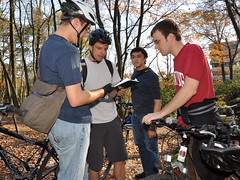
See planning history in Greenbelt by bike

When it comes to the built environment, the Washington region has long been one of the proving grounds for Planning.

From the first-ever National Planning Conference in 1909 to the demonstration of New Urbanism at Kentlands, Washington has benefited from planning ideas that often seemed far-fetched at the time.

Greenbelt, Maryland is no exception. It’s the best-preserved example of New Deal-era utopian town planning in the United States, and has been named a National Planning Landmark. This Saturday, I’m leading a bike tour of the community (details below). I hope you can make it.

About Greenbelt:
Faced with housing shortages, a decimated economy, and deteriorating conditions in cities, the Roosevelt Administration, as a part of the New Deal, set out to build 4 “greenbelt towns” as an example of how suburban development could and should move forward.

Partially inspired by England’s garden city movement, Greenbelt was intended to be a self-contained community surrounded by a green belt of parks, forests, and farms. Today, Greenbelt is not as isolated, but the historic center maintains its park-like setting.

Planning of the town was holistic, in keeping with the principles of the New Deal. In addition to housing, a commercial center was constructed. Civic buildings included an elementary school/community center and recreational buildings.

Perhaps most unique in the design was that residential buildings were turned “inside-out”. Residential structures have their main entrances on the “garden side.” The design of the community meant that pedestrian paths wound through superblocks, where buildings were turned inward toward parks, gardens, and social interaction. At the rear of the units is the street, the so-called “service side.”

Much of the architecture in the community is based on the International style with Art Deco elements. Some elements which are now becoming more common in urban design have been present in Greenbelt for over 7 decades. One example is the “shopping court” at the Roosevelt Center, where shops front on a pedestrian plaza, and parking is in the rear.

Greenbelt was designed with the automobile in mind, but it was not designed for the automobile. I think this is the largest and most crucial difference between Greenbelt and the prototypical post-war suburb. The community is walkable, traffic is calm, and despite being surrounded by sprawl, cars do not dominate the landscape.

The greenbelt towns were intended to be prototypes for suburban development. But the experiment didn’t become typical of suburbia. It did, however, help to inspire several planned communities, including Reston in Virginia, and Columbia and Montgomery Village in Maryland.

The Tour:
This Saturday, October 2, I’ll be leading a bike tour of the community. The tour will be approximately 4 miles in length and will include a tour of the Greenbelt Museum. It will cost $5.

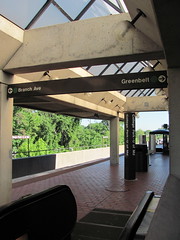
The tour will begin and end at the Greenbelt Metro station. It starts at 1pm and will be complete by 5pm.

If you’re interested in attending or have questions, please email me at mcjohnson@ggwash.org.

Top photo by M.V. Jantzen on Flickr.

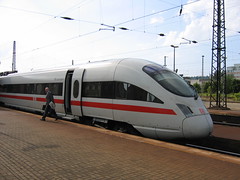
HSR could get you to Boston in 3 hours, but it's pricey

Yesterday, Amtrak announced plans to create a new, exclusive high-speed rail corridor in the Northeastern United States.

The proposal would cost upwards of $117 billion and could be complete by 2040. Trips from Washington to Boston would take only 3 hours.

Amtrak rightly points out that there is almost no better candidate for true, "next-gen" HSR than the Northeast Corridor. But the density in the corridor would also make this easily the most expensive rail project ever undertaken in this country.

The benefits, though, could be phenomenal. In fact, Amtrak expects that the new line could generate an annual surplus of $1 billion (2010 dollars) and could more than triple Amtrak ridership in the NEC from today's level.

Read More -->

Commenting disabled. Please comment in the thread at GGW.

Friday, September 24, 2010

Photo Friday: Looking Forward

I'm trying to bring more content to the blog, and what a better way to start than with another Friday Photo?

VRE 018
I've always loved this shot. I snapped it from the front car
of a VRE train on the Manassas Line headed northbound
into Washington. On the adjacent track, a northbound
Fredricksburg Line train is passing us.

Monday, September 20, 2010

Of Late

Posting here has been light, of late. And I apologize. But there is a very good reason.

Earlier this month, I was named Assistant Editor over at Greater Greater Washington. That has increased my responsibilities and time commitment there, and has decreased the amount of time I have to write at Track Twenty-Nine.

That said, I have no intention of abandoning T29. I plan to keep putting content here, but I doubt I'll be able to maintain the level of posting I had been doing in the past.

I am still writing, though. I generally write several posts a month for GGW. Many of those are specific to the Washington region. but some cover topics that are of interest to a wider group. If you want, you can subscribe to just my posts at GGW.

I would, of course, encourage you to subscribe to all GGW posts. David Alpert has put together an excellent team of writers, and I think you'll find many of their posts engaging and thought-provoking.

And speaking of GGW's influence, I am mentioned (and quoted) a few times in a great article in the Washington City Paper on how David Alpert is helping to shape Washington.

Thanks to all of you for reading! I'll continue to do my best to write about the issues that are important to me and to you.

Tuesday, August 10, 2010

Higher Ground

IMG_2786I recently had the week off, and I took the opportunity to travel to Southern California. It was my first trip there.

Generally when visiting a new place, one of the first things I try and do is find a high point to view the city I'm in. And in Los Angeles, one place stands out among the rest as a place to go: Griffith Observatory.

Standing high up on Mount Hollywood, the observatory offers extraordinary views across the Los Angeles Basin. I visited last Sunday evening, just as the sun began to get low in the sky, and stayed until well after dark.

And the views of the city were well worth the trip. The show at the planetarium was also superb. If you ever go to LA, make sure to visit the Griffith Observatory. LADOT offers a shuttle from the Vermont/Sunset Red Line station every 35 minutes or so on weekends. You can also hike, bike, or (if you must) drive there.

Anyway, more on my experiences and observations from Los Angeles and San Diego later. For now, I'll just show you some pictures from the Observatory.


IMG_2755
Looking toward Century City

IMG_2759
The Hollywood Hills (and Sign)

IMG_2760
Downtown

IMG_2777
The Hollywood Sign framed by one of the arches outside the Observatory

IMG_2788
Sunset

IMG_2859
The Basin

IMG_2897
Downtown again

IMG_2885
From the roof

Thursday, June 3, 2010

Park Police take the wrong approach to safety

Besides closing park bike paths at dark for the "safety" of cyclists, the Montgomery County Park Police have taken another interesting approach to promoting cyclist and pedestrian safety.

This mobile variable message display board has been placed directly on the Sligo Creek Trail near Silver Spring. It's message: "Drive Safely / Crosswalk Ahead / Share the Road." Well, we wouldn't have to share the road if Park Police didn't block the trail with a sign, now would we?

Of course, as a cyclist, I appreciate that the Park Police are encouraging drivers to be on their best behavior. Their hearts are in the right place, but their effort is a bit - ah - misplaced.

Wednesday, May 26, 2010

Streetcar Funding Restorted

It's been a crazy day here in Washington, with the sudden news of the stripping of funding for the H Street Streetcar. However, after a torrent of phone calls and emails, the DC Council has reversed their decision and found the $47 million needed for the line.

Black Wednesday

This morning, the DC Council voted to strip $49 million from the Streetcar program. This budget change was made by the Chariman, Vincent Gray, at 2:00 am the morning of the vote. There was no time for public or council discourse on the issue.

Despite the fact that streetcar rails have already been laid between Oklahoma Avenue and downtown, the DC Council has decided that H Street, devastated in the 1968 riots, does not deserve a second chance at life.

This move jeopardizes the H Street Streetcar and the rest of the streetcar program. The line on H Street was supposed to open in 2012 as a part of a 37-mile District-wide system. The Anacostia Line demonstration project, which was supposed to open in 2006, remains under construction.

Update:
The Council has restored funding to the H Street Streetcar. They were inundated with calls and emails.

Monday, May 10, 2010

Metro's terminal-based wayfinding confusing for visitors

For out-of-towners, navigating the Metro system can be a daunting task. Metro could make directions easier and improve wayfinding in the system by providing more information about train directions on signs.

The system's use of colored lines and destination station to identify train direction works fairly well for Metro, especially given the structure of the system, but it can be confusing to see one train going to Glenmont and another to Grosvenor when neither mean much to a visitor.

Where some trains don't go all the way to the terminal, like on the Red Line, the multiple terminals are even more confusing, especially when two Red Line terminals are two-word names starting with 'S' and the others one word starting with 'G', but one of each is on either end of the line. Other lines downtown also have two terminals in each direction since two colors share a track.

What could Metro do? Other transit systems approach this problem in several ways.

Read More-->

Wednesday, May 5, 2010

DC Puts Streetcar on Display

I just finished visiting the DC Streetcar brought down from Greenbelt yard. I've uploaded a few photos, with more to follow later. You can view my pics here:


If you're in the DC area, the streetcar will be on display at the Old Convention Center site (9th & H NW) from 11-7 though Saturday, except that it closes at 5p on Saturday.

Thursday, April 29, 2010

7000-Series Hiccups and Missed Opportunities

In case you missed it, I published two new posts about the 7000-series on Greater Greater Washington this week.

The first looks at some hiccups in the process, including MWAA's dispute with Metro over costs (which could delay or derail the contract) and Maryland's delinquency, which seems to be nixing the testing/commissioning facility necessary for the new cars.

And the second post looks at significant missed opportunities with the 7000-series, including not adding more doors, failure to transition to articulated trainsets, and a loss of design element uniformity.

Monday, April 26, 2010

The 7000 series: Not your father's railcar

Metro will soon place an order for a new series of railcars. The new cars, the 7000 series, will be quite different from Metro's current fleet of cars.

One notable difference with the cars is that they will be quad-sets. They will still be married pairs, like WMATA's current rolling stock, but instead of having a cab at each end of the pair, a cab will only be present at one end.

A second married pair facing the opposite direction will give the set of four a cab at each end. By eliminating cabs in half the cars, this configuration will give the cars more passenger capacity. A control panel will be located at the other end of each pair to facilitate movement in yards.

Read More-->

Image from WMATA

You Don't Auto-Complete Me

A few minutes ago, I went to Google Maps to find the location of the Chevy Chase Library relative to the Capital Crescent Trail.

With the address in hand, I began typing. It's located at 8005 Connecticut Avenue. On the map below, that's at the intersection of Connecticut and Dunlop.


When I started typing, Google tried to be helpful. "Bulgaria, is that where you're looking? No? Italy? Japan, maybe?"

I mean, my map is already hovering over the area where the library is! I just wanted an exactish location. None of the top 10 suggestions are even in the Western Hemisphere!

Come on Google, you can do better than that, can't you? Ever consider that someone might be typing an address into a maps application?

Saturday, April 10, 2010

Read This

I know my posting's been down lately. I'm working on trying to improve. I have been writing a lot more for Greater Greater Washington and not crossposting here, so if you aren't subscribed to me there, consider signing up for GGW's RSS feed or just the RSS for my posts.

Anyway, I know that I've done a terrible job keeping my sidebar links up to date, and unfortunately, I don't have time for an update at the moment. However, I think all of you interested in transit or planning (or policymaking) should take a moment right now and visit Human Transit.

Human Transit is one of the best blogs I've come across about general transit planning commentary. It's one of the most valuable entries in my RSS feed. And at about a post a day, the information is quality but which does not overwhelm with volume, which can be a problem on other sites.

Here are a few of the posts that I really enjoyed (in order by date of posting, newest first):