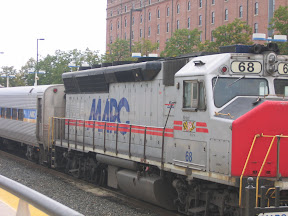
Monday, November 17, 2008

MTA Light Rail Disruptions

Track Twenty-Nine does not typically cover Baltimore, but our friends further up the bay are having some major transit issues that I think warrant a post.

This weekend, MTA Maryland, the agency which runs Baltimore's transit system announced that due to emergency maintenance on their light rail vehicles, major service cuts would be going into effect immediately. These cuts are temporary, but MTA has not yet announced a timetable for renewal of services.

As of November 15, all light rail services north of North Avenue are canceled. A shuttle bus will take passengers to all stops north of North Avenue. Additionally, no service will be provided on the Penn-Camden Shuttle. Buses will take passengers between Penn Station and Mount Royal/U of B Station. On the rest of the light rail system, one-car trains will be in operation, with the potential for serious overcrowding.


Apparently the cause of these disruptions is damage to the wheels of MTA's LRVs caused by "Slippery Rail Season." This season is recognized by many transit agencies, including WMATA, as the time of the year when falling leaves get ground to mush on the tracks. This causes rails to be slippery and reduces traction and braking power to trains. According to MTA, their LRVs are more prone than other systems to be damaged by slippery rail season.

MTA reports that staff are working overtime to resolve the problem. While this is reassuring, I wonder what is being done to keep this problem from being manifested again next year.

If you're up in Baltimore, hang in there, hopefully service will be restored shortly.

*The Metro Subway is unaffected by these problems.

Friday, November 14, 2008

Do You Know the Way to San Jose?

This is a new series I've started for the blog profiling transit systems I've ridden and found interesting.

When I was out west at Railvolution a few weeks ago, I had the opportunity to ride down to San Jose and spend a few hours there. I have to say I was impressed. I was expecting a car-oriented suburban landscape of office parks, but found that the city has a nice core downtown.

The city has a light rail system which operates along 42 miles of track with 62 stations. The system first opened in 1987, and has been upgraded and expanded since. It is operated by the Santa Clara Valley Transportation Authority, VTA. The LRVs currently used on the system are low-floor. They replaced the original fleet of high-floor LRVs in 2003. Platforms are presently being brought up to allow for level boarding.


Portions of the system still are single-track, but most of the system is double-tracked. Still, I found frequencies somewhat lacking. I had to wait almost 30 minutes for a train at Diridon Station. Ridership seemed to be decent considering the context. Approximately 37,000 people board the system every day, putting it in 14th place for American light rail ridership.

Notables:
In my opinion, the San Jose Light Rail offers a few notable practices.

Downtown, the line operates in a pedestrian mall-type environment on parallel one-way streets. The picture at top illustrates this. Here, the rails are embedded in a linear-plaza setting, and between trains people walk and bike along the tracks. With street trees planted only feet away from the sides of the vehicles, the catenary wire is almost invisible. (See UMD, it can be done!)


Additionally, ample space for bikes is provided on board. I've ridden many light rail systems, but nowhere can I remember seeing quite so much space allocated for cyclists. This system is definitely bike-friendly, and I found that interesting, because I never imagined San Jose to be a great bike city. Apparently, however, the two-wheeled mode is popular in the Silicon Valley.

Unfortunately, I only had enough time to ride a small portion of the system. I wish I'd had more time to explore, but I suppose I'll be back in the Bay Area eventually.

Segments Ridden:
San Jose Diridon - St. James,
Lick Mill - Mountain View

Stations Visited:
San Jose Diridon,
San Fernando,
Convention Center,
Paseo de San Antonio,
Santa Clara,
St. James,
Lick Mill,
Mountain View

I'm interested in your opinions on this new segment. So comment with the following questions in mind:

1. What other information would you like to see in the segment "Profiles in Transit?"
2. What thoughts do you have on VTA Light Rail?

Thursday, November 13, 2008

A Day in the Newseum


A few weeks ago, I had the pleasure of taking a trip to the Newseum. Located near the National Archives on Pennsylvania Avenue, the facility is a huge, modern building dedicated to memorializing and exploring the free (and the not-so-free) press.

I've lived in Washington for over a year, and visited many of its museums, but the Newseum is by far my favorite. I'll go so far as to endorse it: If you're in Washington and have time for only one museum, visit the Newseum. But make sure to have plenty of time, the place is vast and is absolutely filled with interesting exhibits.

Of course, the focus of the Newseum is not just the history of the news. Indeed, the museum shows the importance of the media in today's times. From Climate Change to Saturday Night Live, there are plenty of exhibits dealing with the present. And while Stephen Colbert derides the museum as the Newsoleum because he says that it's a place where visitors can see the history of the old, dead news, nothing could be farther from the truth.

The open, airy design of the structure allows for many large exhibits, including a newscopter and part of the transmission antenna from the World Trade Center. I think that the antenna is the centerpiece of the most eerie of the exhibits: it's surrounded by the front pages of all the newspapers reporting the September 11th tragedy. From the Atlanta Journal's "OUTRAGE" to the San Francisco Examiner's "BASTARDS!", this mosaic of sadness and pain is a moving display.

And most breathtaking of all is their terrace. Called the best view of the Capitol anywhere in DC, the outdoor rooftop observation deck is six stories above Pennsylvania Avenue and only 5 blocks from the grand centerpiece of L'Enfant's city. This view alone is worth the admission fee, but the exhibits are a nice byproduct, too.

So, from the 6 segments of the Berlin Wall (including guard tower) on the ground floor to the gallery of today's front pages on the top, this museum is one of the finest gems in Washington. Make sure not to miss it if you find yourself in our nation's captial.

New Poll: The Inaguration

I've launched my first poll on Track Twenty-Nine. Make sure to stop by and vote! The poll closes on November 20.

Metro Service Advisory: 11/15/08

Due to the G-20 Conference this weekend at the National Building Museum, Metro's Judiciary Square Station will be closed for most of Saturday. Red Line trains will continue to pass through without stopping. The station will be closed from opening Saturday, 11/15 until 8PM on Saturday. Additionally, the F Street (National Building Museum) Entrance will close at 7PM on Friday 11/14. Passengers traveling to the area should use Gallery Place/Chinatown on the Red, Green, and Yellow Lines, located a few blocks west.


In addition, construction outside the Navy Yard Station on the Green Line will cause one entrance to be closed on Saturday. The West Entrance (M & Half SE) will be closed from 7am-4pm on Saturday, November 15. The East Entrance, located at M & New Jersey SE, will be open all weekend as usual.

Tuesday, November 4, 2008

GO VOTE!

The day has finally come at long last.

Once every four years, Americans have the opportunity to go to the polls and elect the leader of the free world. This tradition is one of our greatest, and everyone who is eligible should participate.

And whether you would have elected America's first African-American President or the first female Vice-President, it is your right and solemn duty as an American to go and pull the lever, punch the card, or touch the screen to elect your candidate.

So today, you'll find me standing in line up on Upshur Street where I'll be voting on a host of issues. And whether it be snowing (as it was for me during the primaries) or whether I must stand in line for hours, I'll do what it takes to cast my ballot. You should too.

I'm sure this is not the first time that anyone has called an election "the most important in a generation," but I can't remember one that surpasses this one in my (relatively short) lifetime. From climate change to transportation reauthorization; from the war in Iraq to the war on poverty; from healthcare to the energy crisis; from new urbanism to the economic meltdown, America is on the brink of change. Both candidates have promised it and Americans are demanding it.

Hopefully in less than 24 hours, we'll know which direction policy is to take for the next four years.

Track Twenty-Nine is not going to take the step of endorsing any candidate. If you haven't yet made up your mind, I've posted a review of some of the issues important to this blog to help you decide, but it's not my place to tell you how to vote.

But let's not forget, on this most sacred of days for our republic, that there are still some who are not yet free to govern for themselves. Unfortunately, as one of the almost 600,000 residents of the District of Columbia, I too find myself without representation in Congress.

The work of the Founding Fathers is not yet done, and will not be until all citizens of this fair land are given equal representation under the Constitution.

But that's no excuse not to...
...GO VOTE!

Sunday, November 2, 2008

Conference by the Bay

As you know, I recently attended Railvolution in beautiful San Francisco. As always, the conference was stimulating and inspiring. I saw old friends and colleagues, met other transportation planners and advocates, and sat in on informative sessions. I highly encourage all of you to try and attend in Boston next year.

The conference was very clear on the point that the next year will be very important for transportation in this country. With the reauthorization of the transportation bill (or "authorization", as we were encouraged to call it) due next fall and an administration committed to change (both Obama and McCain have called for it), transit may hope to make gains next year.

We as citizens, however, must take action. In one session I attended, we were told that because the transit advocacy community was silent, transit was left out of the recent climate bill. We cannot delay in writing our elected officials and encouraging them to support transit as a way of reducing pollution and our dependence on foreign oil.

There were also speakers from the world of policy who are working to improve our urban areas. One of the highlights of both of my Railvolutions has been the speech by US Congressman Earl Blumenauer of Oregon. The Congressman is one of the tireless champions of transit in Washington and he is dedicated to working with the new administration to get transit moving in the United States. Also speaking was Janette Sadik-Khan, commissioner of the New York City DOT. NYC DOT has been making huge strides recently to reclaim urban space for pedestrians, cyclists, and transit users.

My favorite session this year, however, was the session on blogging. Even though I already blog, I found the session informative and engaging. I also thought it was the best-geared session (that I attended) for advocates. After all, electronic media offers so many new ways of displaying information and interacting with readers.

I do think that there were fewer advocates at the conference this year. Last year, I met many in the advocacy community, but this year the conference seemed to be more professional-focused. I think that advocates add a lot to the conference, and I hope that more of them are able to attend the Railvolution in Boston next fall.

Of course, I took the time while in the Bay Area to ride the transit systems out there. I plan on reflecting on these individually over the next few days, but the experience was very positive. I'd already ridden BART and Muni, but I was able to add to my list Caltrain, VTA light rail, ACE, and Sacramento's light rail. Incidentally, I also rode the Minneapolis Hiawatha Line during my layover there on my way home.

Adding these systems has furthered my goal of riding every rail transit system in America. I've now ridden 51% of light rail systems and 45% of commuter rail systems. (Yay!)

Sunday, October 26, 2008

Streetcars, Version 2.0

I know it's been a long time since I posted my last streetcar map, but school has kept me extremely busy lately. I've been working on incorporating your suggestions and I think I've developed a better map. I'll let you judge that for yourselves, however.

Like all of my plans, this is a conceptual best-case scenario based on what I think the region can support right now. This is not meant to reflect what I'd like the streetcar network to look like in 15 years, it's what I'd like it to look like tomorrow. Since that is clearly not possible, I'd be happy if any one of these proposals, in part or in whole, was constructed.


Mainly, this plan is to stimulate discussion. If we're lucky, this plan, or one of my readers, will spur the District Council into action. And even if we're not that lucky, this represents a vision for the region of what we could become. Plus it's fun for me. I hope you enjoy reading it as well.

From the Streetcar Plan 1.0:

I chose lines based on connection commercial nodes. I know that some of the
lines are long. Not very many people will ride from Friendship Heights to the
National Archives, but that’s not the point. I once heard Portland’s Streetcar
referred to as a “pedestrian accelerator.” The point in to expand the range of
people going on foot, encourage redevelopment, and offer alternatives.

Streetcars would operate like Portland Streetcar, with traffic in shared lanes. Vehicles would be similar to those used on Portland Streetcar and the South Lake Union Streetcar in Seattle.

One final note: Station locations are conceptual. I picked certain intersections because they were evenly spaced or home to a major commercial node. There may be better stops that should be included, and I imagine that studies will be undertaken before any construction begins. Feel free, however, to make suggestions.

14th Street/Capitol Hill Line
This line, shown in dark blue on maps, starts in Northwest at the intersection of 16th Street and Gallatin Street. This stop, near the Rock Creek Tennis Center, would be a transfer point to theWestside Light Rail proposed in my Major Transit Plan. The line runs south along 14th through downtown, turning east on D Street SE to jog over to 7th Street at L'Enfant Plaza. Turning south on 7th, the line heads for the Waterfront. Passing through the Riverfront District
on M Street, the line heads for Barracks Row. A loop is located at the M/8th Street intersection to short-turn streetcars. The line continues north on 8th Street through the historic district. The line crosses Pennsylvania Avenue and turns right onto Independence Avenue, then north on 19th Street. Jogging over to Oklahoma Avenue on D Street, the line enters a loop at Oklahoma Avenue & Benning Road, site of the Oklahoma Avenue Station on my proposed Silver Line/H Street Subway.

Wisconsin Avenue/Anacostia Line
This line, colored purple on the map, runs across town, with a branch at either end. On the west end of the line, trains head from Georgetown to Friendship Heights or the Court House section of Arlington. At the east end of the line, trains cross the 11th Street Bridge over the Anacostia and follow MLK to Congress Heights or Good Hope Road to Naylor Road Metro.

The Friendship Heights Branch is unchanged from version 1.0. Turning at a loop at Wisconsin and Western, the line runs down Wisconsin to Georgetown where it meets the Arlington Branch.

The Arlington Branch is also unchanged from version 1.0. Trains operate from Georgetown to Court House Metro by way of the Key Bridge and Wilson Boulevard.

From Georgetown, trains from both branches operate down Pennsylvania Avenue to K Street, after going around Washington Circle. Passing through downtown on K Street, the line jogs around the south side of Mount Vernon Square, turning southeast onto Massachusetts Avenue. Past Union Station, the line continues (on a new alignment from version 1.0) down Massachusetts to 2nd Street. At Pennsylvania, the line turns southeast in the median running as far as 8th, where it turns south. Along 8th, the Wisconsin/Anacostia Line is multiplexed with the 14th Street Line as far as M Street. Turning east on M Street, the line climbs onto the proposed 11th Street Bridge over the river. On the south shore, trains split into the two branches.

The Good Hope Branch goes through the center of old Anacostia. Passing through Southeast DC, the line crosses Alabama Avenue and turns south onto Naylor Road. At the DC Line, the streetcar enters Maryland and goes around a loop at the Naylor Road Metro Station.

The MLK Branch travels past the Anacostia Metro Station on its way to Congress Heights. At South Capitol and Mississippi Avenue, the streetcar turns around at a loop. Transfers are available here to the Eastside Light Rail proposed in my Major Transit Plan.

H Street/State Department Line
This line, which is light blue on the map) is relatively unchanged from version 1.0. The only difference is that I've extended it across the Anacostia River on the Benning Road Bridge to feed into a new station I am going to propose on my plans at River Terrace, a la Greater Greater Washington and Imagine DC.

The line runs from the State Department up 23rd Stret to Washington Circle, thence east on K Street (along with the Wisconsin/Anacostia Line) to Mount Vernon Square. From Mount Vernon Square, it turns southeast on Massachusetts Avenue past Union Station to D Street NE. The line uses a pair of one-way streets (SB on 4th NE, NB on 6th NE) to get up to H Street. The line sticks with H Street and Benning Road to a loop at River Terrace Metro.

Connecticut Avenue Line
This line (green on the map) starts at Chevy Chase Circle, and proceeds south through Northwest to Dupont Circle. Turning south on 20th Street then east on Eye Street, the line crosses downtown. A turn down 12th Street takes cars past Metro Center. Turning east on Constitution then north on 7th, the line reaches its end at a loop at 7th & Indiana.

Georgia Avenue/Mount Pleasant Line
Starting at the old streetcar loop in Mount Pleasant, this line, colored orange, travels south on Mount Pleasant Street to Columbia Road. Turning southwest on Columbia, the line is multiplexed with the Crosstown Line for several blocks. At 18th, the line turns south to travel through Adams Morgan's commercial corridor. Turning right on Q Street, the line crosses Connecticut Avenue and follows the Connecticut Avenue Line through downtown. From 7th & Indiana, the Georgia Avenue Line continues north on 7th Street, past Gallery Place Metro. The line follows 7th Street/Georgia Avenue to Silver Spring, where it terminates at the Silver Spring Transit Center, which is currently under construction.

Rhode Island Avenue Line
This line, also colored orange, is part of the Georgia Avenue Line. Sharing the downtown portions of its line, it runs from a loop at 20th and L NW to Mount Rainier. Splitting from the Georgia Avenue Line at 7th and Rhode Island, the Rhode Island Avenue Line travels northeast on Rhode Island all the way to Mount Rainier. At Mount Rainier, it turns back on a siding at Rhode Island Avenue and Perry Street.

Boundary Street Line
This line has undergone a few changes since version 1.0 based on your comments. In the east, it starts at River Terrace on the opposite bank of the Anacostia. This change was made because I'm including a stop there in the next version of my metro proposal. Traveling westward, the line follows Benning Road and Florida Avenue. Turning onto U Street, the line crosses through Washington's L'Enfant City. At U and New Hampshire, the line turns southwest, intersecting the Georgia Avenue Line at 18th Street. Turning west on Q, the line heads toward Georgetown. At Wisconsin, the line turns south and joins the Wisconsin Avenue Line. Turning right at M Street, passengers can change to the metro at the proposed Georgetown stop. Trains then enter a loop made up of one-way streets. Trains travel north on 33rd to P, where they turn west, turning south again at 37th. Here passengers can access Georgetown University. Continuing around the loop, trains turn left onto O Street, right onto 34th, and then left onto M Street.

Crosstown Line
This line has seen the most change since version 1. The Crosstown Line is colored red on the map. It runs from Woodely Park in the west to North Michigan Park in the east. From Woodely Park, it crosses the Calvert Street Bridge over the Rock Creek Gorge, turns northeast onto Columbia Road and then east on Irving after traveling north for a block on 16th. Following Irving, the streetcar passes through Columbia Heights and joins Michigan Avenue south of the Washington Hospital Center. Turning onto Monroe, the streetcar passes the Brookland Metro stop, and after a turn onto 12th, passes through the center of the Brookland neighborhood. Continuing north on 12th, the line once again follows Michigan, ending at a loop at Michigan and Eastern.

Maintenance/Storage:
The streetcars need a place to be stored overnight and also a venue where maintenance can be performed. If other cities examples can be followed, new development along the corridor could be made to accommodate a trolley barn as a condition of zoning approval.

At least two locations do seem to have immediate potential, however. At Oklahoma Avenue Metro, the parking lots at RFK will be redeveloped. However, it seems possible that room for Trolleys could be left somewhere on site. Additionally, if non-revenue tracks led south from Rhode Island Avenue along Eastern Avenue near Mount Rainier, a Trolley storage/maintenance facility could be constructed on the industrial sites south of the CSX Capital Subdivision (MARC Camden Line).

I've also included a few other potential trolley barn locations, but these are just conceptual ideas. check out the google map to find their locations. Again, they could be sited in new development and would not be obtrusive.

Additionally, it might be possible to return WMATA’s Northern Bus Garage in 14th Street Heights to trolley service.

Non-Revenue Tracks
I've included on the google map version some potential non-revenue connections. These are tracks that would link lines together for easy movement of rolling stock, but would not be used for passengers. They are shown in black.


View Larger Map

What other corridors do you think would support a streetcar?

Saturday, October 25, 2008

A Californian Railvolution

Last year, I had the wonderful opportunity to travel to Miami to attend my first Railvolution. This year, I'm going again.

The conference will be in San Francisco this year, and I will certainly be reporting back on the conference and the state of transit in the Bay Area.

Perhaps I'll see some of you there. If not, I apologize in advance for light posting over the next week.

Start saving up for a trip to Boston for next year's conference!

Friday, October 24, 2008

Recession Threatens Transit

In September of 1929, the City of New York proposed an ambitious 100 mile proposal for what was known as the IND Second System. The plan would have greatly improved service on the city's subways and would have increased access for residents. Remnants of the plans remain to this day with unused platforms and tunnels, but by and large, the plans are lost to history.

Before the ink on the plans was even fully dry, America and the world were struck by the disastrous October 24, 1929 crash of the stock market. The dreams of transit planners weren't the only ones shattered on that black Thursday, but the consequences have been long-lasting for New Yorkers, whose subway system hasn't launched a major expansion since the 1940 unification of the three systems.

Today, I fear similar consequences will ripple out from the Credit Crisis.

Six months ago, Americans were languishing with high gas prices and were clamoring for alternatives. People wanted to reduce their dependence on foreign oil, they wanted to expand transit, and they were thinking about moving to more walkable neighborhoods.

Now, the recession has knocked the legs out from under gas prices, which have dropped precipitously in the last month. The price of oil has dropped to under $70, down from a peak of $147 in July. Whether Americans will start driving more as a result is as yet unknown, but the consequences may be severe for the environment and for new urbanism.

Also, with many Americans out of work, initiatives, like California's High Speed Rail vote, which will be on the ballot this November may suffer. Taxes are rarely popular, but sometimes Americans are willing to tax themselves to improve communities. Recessions are never a good time for these initiatives, and 2008 might not turn out to be such a great year for transit after all.

But the consequences of the Credit Crisis are already manifesting themselves. The Washington Post reported today that WMATA and other transit agencies are having their debts called in by banks in the face of AIG's collapse. Apparently, one Belgian bank has demanded that Metro fork over $43 million by next week.

The situation is certainly a complicated one, but the federal government encouraged transit agencies to leverage funding from the private sector by selling interest in rolling stock to banks. Since transit agencies are exempt from taxes, the banks got a large write-off. Don't worry, FTA approved all the deals and there was nothing illegal going on.

The hitch comes into play, however, because the third-party guarantor in most cases was financial giant AIG, whose woes over the last few weeks took all the deals into default. Because the IRS will grant amnesty to companies that drop their tax shelters by the end of 2008, banks are under a lot of pressure to kiss the transit agencies goodbye.

WMATA, which made around $100 million between 1997 and 2003 is potentially on the hook for quite a pretty penny. And they're not alone. According to the Post's article, transit agencies in Los Angeles, San Francisco, Atlanta, and Chicago could all face major service cuts or other financial hardships as a result of this fiasco.

It would be a shame for the economic crisis to kill plans for transit expansion, especially after the momentum that transit has gained over the last few months. How the government deals with the economic situation and America's infrastructure problems will depend very much on who is elected in a little less than two weeks.

Transportation reauthorization is coming up next year with the expiration of SAFTEA-LU. This could be an opportunity to redefine the way America approaches infrastructure and metropolitan planning. But the threat is very real that the Credit Crisis will divert needed attention from transportation. And with falling energy prices, Americans might go back to the illusion that they can continue to drive SUVs everywhere indefinitely.

I hope I'm wrong. I hope that this all blows over, not only for transit's sake, but because a recession is never a good thing--for anyone. Still, we cannot afford to ignore the plight of transit. Perhaps the Treasury Department has a bailout with the transit authority's name on it.

Thoughts?

Friday, October 17, 2008

Purple Line DEIS Released

The Maryland Mass Transit Administration has released the Draft Environmental Impact Statement for the Purple Line. The document, sprawling across 251 pages offers a comprehensive look at the alternatives proposed for the transitway.

Running approximately 16 miles from Bethesda in Montgomery County to New Carrollton in Prince George's County, the line will be either Bus Rapid Transit (BRT) or Light Rail and will cost between $386 million and $1.6 billion depending on the selected alternative.

The DEIS does not make for light reading, but it does cover a variety of important topics, from environmental justice to watershed impacts. Ridership and cost projections are also included, and this document is an important step in getting federal money to complete the project.

The project will play a vital role in connecting the region. Even the lowest investment BRT alternative is expected to garner 40,000 daily boardings by 2030. The high investment light rail line would draw over 68,000 riders by 2030.

The DEIS does not identify a locally preferred alternative (LPA). The decision about which mode and alignment will be made after public comment on the DEIS. According to the document:

After consideration of comments received the State of Maryland will select a Locally Preferred Alternative in consultation with county and local jurisdiction officials and elected officials. The selection will be based on consideration of, and trade off among benefits, costs, environmental impacts, and affordability of the alternatives. The Locally Preferred Alternative could include project implementation phasing that involves an initial implementation phase, referred to as a minimum operable segment, and a plan and schedule for subsequent implementation phases.
(DEIS, page 13)

Selection of an LPA would allow the MTA to undertake the engineering required for the Final Environmental Impact Statement (FEIS) which is the last major step before requesting a record of decision from the Federal Transit Administration.


The DEIS can be accessed here (warning, large PDF).
Other documents are available on the Purple Line website.

Meetings are being held around the region soon. Make sure to get your comments heard.

New Carrollton
Saturday, November 15
10:30AM-3:00PM
New Carrollton Municipal Center
6016 Princess Garden Parkway
New Carrollton, MD 20784

Chevy Chase
Tuesday, November 18
4:30PM-9:00PM
National 4-H Youth Conference Center
7100 Connecticut Avenue
Chevy Chase, MD 20815

College Park
Wednesday, November 19
4:30PM-9:00PM
Ritchie Coliseum, University of Maryland
Route 1 across from Rossborough Inn
College Park, MD 20742

Takoma Park/Silver Spring
Saturday, November 22
12:30PM-5:00PM
Montgomery College,
Takoma Park/Silver Spring Campus
Falcon Hall
7600 Takoma Avenue
Takoma Park, MD 20912

Thursday, October 16, 2008

Ridership Higher, Service Being Reduced

Despite rising ridership on Maryland's MARC train, MTA is proposing service cuts, beginning before year's end. MARC is a commuter and regional rail service operating between Washington and Baltimore, with limited service north of Baltimore, and between Washington, Frederick, and Martinsburg, WV.

Just a few months ago, MTA was proposing an expansion of MARC service, including weekend service on the Penn Line and midday service on the Camden Line. Governor Martin O'Malley had named MARC expansion one of his top priorities and the ambitious MARC Expansion Plan called for a tripling of MARC Service by 2035.

With high gas prices, MARC ridership was way up. Many trains are standing room only leaving Washington Terminal, including some trains that still have standing passengers when they arrive in Baltimore.

But the slowing economy has led to decreased revenues. The governor has ordered across-the-board cuts, and MTA is not exempt. In addition to reductions in service on commuter bus lines, MARC will be taking a hit too. The proposed cuts are listed below. They will go into effect on January 12, 2009 except for holiday service cuts, which will go into effect sooner.

These cuts are part of a phenomenon being seen across the nation. They are indicative of a transportation funding mechanism which is broken. Although Maryland claims to be a smart growth state, cuts to transit are affecting thousands of commuters, while construction continues to progress on the sprawl-inducing Intercounty Connector (ICC). These cuts come at a time when we are trying to reduce our dependence on foreign oil and when we are trying to reduce the climate impacts of our auto-centric society.

The state is between a rock and a hard place, and I certainly understand the need to cut spending. However, these cuts will take Maryland in the wrong direction. America's transportation infrastructure is decaying, transit ridership is up, and smart growth continues to blossom. Now is not the time for cuts to MARC service.

Please write to MTA and your local legislator and governor O'Malley to object to these cuts. A letter to the presidential candidates wouldn't hurt either. Next year may prove to be a watershed year for transportation investment--or the year we let it all go down the tubes. If the economy is issue number 1, transportation is issue number 2. It influences our environmental, energy, urban, and foreign policies and we cannot afford not investing in it any longer.

Hearings are being held throughout the region on the proposed MARC cuts. The schedule is available here.

Comments regarding these cuts may be made to MTA:
By Mail:
Mr. Glenn Litsinger
MTA Office of Customer Information
6 St. Paul Street
Baltimore, MD 21202

By Email:
marc@mtamaryland.com
“Hearing Comments” as subject

ALL COMMENTS MUST BE RECEIVED BY 5PM, MONDAY, DEC. 26

Currently proposed for elimination:

Evening Service: Penn Line trains 445, 446, 447, & 448
This cut will eliminate two round trips from Washington to Baltimore. Currently, the last train leaves Washington for Balto. at 11p, arriving at Penn Station at 11:59p. The last train leaving Baltimore for Union Station is at 9:30p, arriving at 10:35p. With the cuts, the last Baltimore-bound MARC train will leave DC at 8:40p and get into Baltimore at 9:36p. It will continue on to Perryville. After the cuts, the last MARC train bound for Washington will depart Baltimore at 7:25p and arrive in Washington an hour later.

Brunswick Line Service: Train 871 eliminated Mon-Thur
The proposed cuts will eliminate the first departure from Washington on the Brunswick Line Mondays through Thursdays. The existing 1:45p departure will remain on Fridays, but on the other four days of the week, the first train to go to Brunswick will depart at 3:35p.

West Virginia Service: Cutback of Train 883 to Brunswick
The cuts will also reduce service at MARC's three West Virginia Stations to 2 outbound trains. The last Brunswick line departure will remain 7:15p, but Train 883 will stop at Brunswick. Passengers headed to Harpers Ferry, Duffields, and Martinsburg will have to catch the 5:35p departure of Train 879 in order to get home.

Elimination of Holiday Service:
While MARC already doesn't operate on Martin Luther King Day, President's Day, Memorial Day, Independence Day, Labor Day, Thanksgiving, Christmas, and New Year's Day. MTA also proposes to eliminate service on Columbus Day, Veterans' Day, the day after Thanksgiving, and December 26.

Reduction of Winter "Holiday" Service:
On December 24th, January 2, and the period from December 27 to December 31, MARC will operate only holiday service. Currently, trains operate on a full schedule on these days.

Laurel Bus Connection: Elimnation of Odenton Shuttle
The cuts will eliminate the shuttle bus which operates from Odenton to Laurel completely. This is a far cry from the proposed implementation of midday service on the Camden Line. This bus currently represents the only way to use MARC to get to the Laurel area between rush hours.

Wednesday, October 8, 2008

Confessions of a Foamer

I have to confess that I am an unabashed Foamer. For my whole life, I've been fascinated by trains. I don't know why this is the case, but I certainly live up to the moniker given to railfans by foaming at the mouth at the mere sight of a train. I am particularly interested in transit, again for reasons beyond my comprehension. This proclivity has labeled me as a "metrophile".

One of my life goals is to ride every rail transit system in America. I've done a fairly good job, I think. There are plenty left for me to visit. I have finished riding all the systems in Canada, but that trip didn't get me any closer to my American goal.

I've created this map to show the heavy, light, and commuter rail systems in the United States. For simplicity's sake I've left off other modes, but they are mentioned below. This is a diagrammatic map, it does not represent actual alignments.

I've listed the all of the Rail Transit Systems in the United States below. I have ridden those in boldface. I did not include heritage streetcars or systems that are completely self-contained, such as airport people movers and the like.

Heavy Rail (11/13, 85%)
  • Atlanta: MARTA
  • Baltimore: Metro Subway
  • Boston: T (Red, Orange, Blue)
  • Chicago: L
  • Cleveland: Red Line
  • Los Angeles: Metro (Red, Purple)
  • Miami: Metrorail
  • New York: PATH
  • New York: NYC Subway
  • Philadelphia: PATCO Speedline
  • Philadelphia: SEPTA (BSS, MFSE)
  • San Francisco: BART
  • Washington: Metro

Light Rail (10/24, 42%)

  • Baltimore: Light Rail
  • Boston: T (Green)
  • Buffalo: Metrorail
  • Camden-Trenton: River Line
  • Charlotte: Lynx
  • Cleveland: Blue/Green Lines
  • Dallas: DART
  • Denver: The Ride
  • Houston: Metrorail
  • Jersey City: Hudson-Bergen Light Rail
  • Los Angeles: Metrorail (Blue, Green, Gold)
  • Minneapolis: Hiawatha Line
  • Newark: City Subway
  • Philadelphia: SEPTA (Subway-Surface, Routes 101/102)
  • Pittsburgh: T
  • Portland: MAX
  • Sacramento: Light Rail
  • Saint Louis: Metrolink
  • Salt Lake City: TRAX
  • San Diego: Trolley
  • San Diego: Sprinter
  • San Francisco: Muni Metro
  • San Jose: VTA Light Rail
  • Tacoma: Link

Light Rail Under Construction

  • Phoenix (Dec. 2008)
  • Seattle (summer 2009)
  • Norfolk (2010)

Commuter Rail (7/20, 35%)

  • Albuquerque: Railrunner
  • Boston: T (Purple)
  • Chicago: Metra
  • Chicago: South Shore Line
  • Dallas-Fort Worth: TRE
  • Los Angeles: Metrolink
  • Miami: TriRail
  • Nashville: Music City Star
  • New Haven: Shore Line East
  • New York: Long Island Railroad
  • New York: Metro-North
  • New York: NJ Transit Commuter Rail
  • Philadelphia: SEPTA Regional Rail
  • Salt Lake City: Frontrunner
  • San Diego: Coaster
  • San Francisco: Caltrain
  • San Jose: ACE
  • Seattle: Sounder
  • Washington: MARC
  • Washington: VRE

Commuter Rail Under Construction

  • Portland (Jan 2009)
  • Austin (April 2009)

Modern Streetcar (1/3, 33%)

  • Portland, Portland Streetcar
  • Seattle, South Lake Union Streetcar
  • Tampa, TECO Streetcar
Miscellaneous (1/7, 14%)
  • Detroit: People Mover
  • Jacksonville: Skyway
  • Las Vegas: Monorail
  • Miami: Metromover
  • Morgantown: PRT
  • Philadelphia: Norristown High Speed Line
  • Seattle: Seattle Center Monorail

Friday, October 3, 2008

Candidates and Transportation

As you're all aware, election day is rapidly approaching. Some Americans have already gone to the polls to vote, and this election sure is shaping up to be an exciting one. I talked about the candidates views on energy recently, and now it's time to address Track Twenty-Nine's issue number 1: Transportation.

In regards to transportation, the candidates are about as far apart as two people can be. Well, actually, I'll try and be more accurate: they're about as far apart as two politicians can be. My views are somewhat further from Senator McCain's than are Senator Obama's.

The largest difference between the candidates is at the fundamental level. Both agree that Americans need to reduce our dependence on foreign oil, but the similarities end there. Senator McCain may want to lower the amount of oil that we import, but he does not see reducing dependence on the automobile as a solution. In fact, many of Mr. McCain's policy positions seek to increase America's automobile addiction. Instead of sending our country into detox, he's just exchanging our foreign-cut with domestically extracted oil.

Senator Obama, on the other hand, wants to give Americans alternatives to driving. He also wants to reshape federal policy so that our communities can be made more walkable, livable, and transit-friendly. He recognizes the dire state of our nation's infrastructure and seeks to create funding sources, including leveraging private dollars, to keep our bridges from falling down and to keep our trains on track.

Senator Obama's pick for Vice President also earns him a gold star in my book for good transportation decision making. Senator Joe Biden has been commuting to Washington from his home in Delaware by Amtrak since he took office in 1973. He has long been an outspoken supporter of rail in this country, something that he will likely continue to advocate for as Vice President.

Senator McCain picked the governor of Alaska as his running mate, and that does not bode well for his credentials, at least not in the transportation sector. After clamoring for an earmark to build a bridge to Gravina Island, Governor Palin cancelled the bridge when the political tide turned against it. She still built the road to it anyway, and without the bridge, it's even more of a waste. At least with the bridge, people would have used the road.

Here's a brief breakdown of the candidates' positions:
Lists are not exhaustive.

Senator Barack Obama's Transportation Platform:
  • A top priority of the campaign is to strengthen our existing infrastructure.
  • Will create 1 million jobs through transportation investment.
  • Would create a National Infrastructure Reinvestment Bank to enhance and supplement federal transportation funding.
  • Leverage private investments through the infrastructure bank.
  • Supports federal funding for Amtrak.
  • Supports the development of high-speed passenger and freight rail systems.
  • Will double JARC funding to increase access to jobs for inner-city residents.
  • Will increase funding for public transportation.
  • Wants to raise transit/ridesharing benefits in tax code to the level of driver benefits.
  • Will strengthen the role of MPOs.
  • Supports requiring states to plan for energy conservation in transportation planning.
  • Supports a carbon cap/trade program.
  • Would offer incentives to transition to/develop alternative fuels.
  • Calls for a doubling of fuel efficiency standards within 18 years.
Senator John McCain:
(Website does not specifically list transportation as an issue)
  • Has called for a suspension of the federal gas tax.
  • Supports tax credits and other incentives to encourage alternative fuel development.
  • Believes that Amtrak is a symbol of government waste.
  • Would encourage telecommuting.
  • Thinks the solution to America's energy problem is to "drill, baby, drill."
While this list cannot be exhaustive, I did my best to compile information. Senator McCain's campaign website does not put much emphasis on transportation. A search of the site for the term "transit" returned hits where he refers to oil's transit routes (as in something that terrorists or dictators could disrupt) and border transit points.

The Brookings Institution has created a nice table comparing the candidates' opinions on transportation.

This election comes at a pivotal time for America. Oil Prices are at record highs. Ridership on transit and Amtrak is higher than it has been in decades. In the south, people can't even get gasoline. Scientists tell us that without a major shift in greenhouse gas emissions, global warming will only accelerate. We cannot afford to ignore these issues, yet one candidate out there seems to find them not worth mentioning.

November 4 is a very important day for America. Make sure you remember to go vote.

Wednesday, October 1, 2008

Money, Money, Money

The Washington Post is reporting that the US Senate has approved $1.5 billion in funding for Metro. This development from Wednesday night follows passage by the House of Representatives last week and because it passed with a veto-proof margin, President Bush is unlikely to veto it.

The funding had been tied up by a lone senator from Oklahoma, Tom Colburn. He objects to all earmarks, not just ones for Metro, but the bill was finally passed as a part of a rail safety bill which will give $13 billion to Amtrak.

The funding will be doled out over the next 10 years, if matching funds can be made available by the jurisdictions. This is very likely because the District and Maryland have already set up their funding sources and Virginia has a law which requires that they match federal funds (they can't leave them to expire). Governor Kaine has promised to find the funding, amounting to $50 million a year from each of the jurisdictions, even at the expense of other transportation projects.
Just last week, Metro announced $11 billion in funding needs for the next decade. This bill will provide $3 billion toward that goal ($1.5 billion from the federal government, $1.5 billion from the states). More funding will need to be found in order to keep Metro running smoothly, but this is a giant step forward.

Incidentally, Senator Obama voted for the bill. Senator Biden did not vote on the legislation, but I think his former commute pattern speaks for itself.

Senator McCain voted against it.
Governor Palin can see Russia from her house. (Not really)