Tuesday, June 23, 2009

Metro Service: 6/23

Due to yesterday's fatal Metro collision, service on the Red Line will be disrupted during the AM peak, if not longer. Additionally, there will be NO BRUNSWICK LINE service on the MARC commuter rail. 

The Red Line will operate in two separate segments: from Glenmont to Silver Spring and from Shady Grove to Rhode Island Avenue. Free shuttle buses will connect Rhode Island Avenue, Brookland, Fort Totten, Takoma, and Silver Spring Stations. Trains on the Red Line will be operating 8-10 minutes apart, quite a bit less than the normal 2-3. Passengers can expect overcrowded conditions. 


Passengers should try to keep to alternate routes if possible. Shuttles will likely be overcrowded, so patrons should try the normal bus routes. 

Alternatives include:
  • 70s Line, Georgia Avenue/7th Street: Archives to Silver Spring
  • S Line, 16th Street: Downtown to Silver Spring
  • C4: Twinbrook to Wheaton to Prince George's Plaza
  • C2: Twinbrook to Wheaton to College Park
  • J1: Medical Center to Silver Spring
  • J2, J3, J4: Bethesda to Silver Spring (J4 to College Park)
  • Q2: Rockville to Wheaton to Silver Spring

Monday, June 22, 2009

Red Line Collision Mars Commute

The big news of the evening was a collision between two Red Line trains on the DC Metro. The most recent reports tally 6 deaths and more than 70 injuries. The crash between two inbound trains occurred under the New Hampshire Avenue overpass, just north of Fort Totten station. The accident happened at about 5:02p. 

I work in Silver Spring, a Red Line stop north of the crash site. I live in DC's Petworth neighborhood, just off the Green Line. At the time of the accident, I was still at work, although I was preparing to leave. Every day I travel over this stretch of track, and my commute was quite a bit longer this evening. I thought I'd post a few of my observations from today.

Firstly, I found out about the incident not from WMATA, but from Maryland's MTA. The MTA operates MARC commuter trains, and I'm subscribed to their service announcements. They announced that Brunswick Line trains would be holding at Union Station indefinitely due to the incident. 

Needing to know how to get home, I tried Metro's website, which was receiving so much traffic that it refused to load. Originally, WTOP reported that trains were operating between Glenmont and Takoma, where I could transfer to my local bus line (50s Line). However, when I got to Silver Spring Metro, the station manager just repeatedly yelled "No Trains, No Trains, No Trains." There was no crowd of people, he just kept repeating it. When I approached, he just repeated it with more focus. This was despite the fact that I could hear the train operator upstairs announcing that her train was going to Glenmont. And while the vast majority of commuters do travel toward DC, some do commute to Glenmont. Therefore it was not entirely expedient to announce "No Trains." 

I met my boyfriend, who also works in Silver Spring, at the nearby McDonald's. He had left work at 5:00, and gone to Silver Spring like usual. He boarded a train, which was held "due to delays" for a few minutes. After about 10 minutes, the train was taken out of service, and everyone was told they would not be able to go downtown. Stranded, and unaware of local bus routes, he called his brother to come pick him up. I caught a ride with them to College Park, where I could catch the Green Line.

At the station, I was surprised to hear the announcements. They reported that due to a "train experiencing mechanical difficulties," major disruptions were occurring on the Red Line. Mechanical Difficulties? That's a bit light Metro. It also didn't jibe with the PIDS screens, which reported Red Line service disruptions because of "police activity at Fort Totten." It seems a bit disingenuous to underrepresent something like this. Most passengers have alternative methods to find out about these things (e.g. cell phones), and to attribute 6 deaths to "mechanical difficulties" is a bit of a stretch. 

I got off at Fort Totten, because I was curious. I walked toward the scene, to see what was visible. I passed a person waiting on the Shuttle, who wondered why he had to find out about this from his Aunt in Florida and not from Metro. I heard others on the news later espouse similar views. From Metro, mum was the word.

The area around New Hampshire and First NE was wild. News crews littered the fringe of the scene, with knots of onlookers scattered about. Most of the area closest to the overpass was roped off, with police, fire, and rescue personnel still working on the search for the injured. Walking further up, I eventually caught a glimpse of the rear of the second train, but I couldn't see the telescoped car. There were fire trucks and ambulances from several jurisdictions, including Kensington and Wheaton in Maryland. Also present was the Prince George's County Ambulance/Bus. 

Finally, I trekked back to Fort Totten, and rode the Green Line home. I'm not fearful of riding the Metro. In fact, I have little alternative, but it's still the safest mode of travel in the region. The last time an accident killed a Metro rider was in 1982. Hopefully it will be a lot longer until the next time. 

Photos from my trek. All photos are from/on Blair Road south of Oglethorpe Street.

The next one is actually from 1st and New Hampshire NE.


Sunday, June 21, 2009

Brown Shirts and Red Caps

Since not all of you follow conservative blogs, you might have missed it when a popular US Congressman called Amtrak a fascist organization. In a column earlier this week in the American Daily Review, former presidential candidate and Congressman from Texas, Ron Paul, rails against - well against the government really - but in this case, he's particularly upset by "bailouts."

He is most angered by the recent federal bailout of (and subsequent controlling interest in) General Motors. To make his case, he falls back on the most favorite of conservative pastimes, attacking Amtrak. Of course comparing it to fascism is a new twist, but the general meat of his argument is pretty consistent with what conservatives have been saying about government-supported passenger rail since the Nixon Administration.

Mr. Paul asserts that the promise that the government takeover of GM is temporary is false. As proof he cites the government "purchase" of Amtrak. Mr. Paul claims that the government promised to be out of the passenger rail business within 3 years, but that now, 40 years later, with billions invested, Amtrak is still a fiscal loser. Mr. Paul also claims that the government is so inept at running things that despite making Amtrak a monopoly, it's still unprofitable. He worries that same things will be the case with GM.

He is right about one thing: Amtrak is a fiscal loser. Mr. Paul's other claims are inaccurate. No promises were ever made about a sunset on Amtrak. The Nixon Administration had made secret assertions that Amtrak would wither and die before the rollingstock could be repainted, but despite Nixon's hopes that one last hurrah would be sufficient to let passenger service on America's railroads end, the American public and Congress had different ideas. Even today, support for Amtrak keeps conservative politicos at bay.

More importantly, Amtrak is not a monopoly. Besides having to compete with cars and planes, which are also subsidized by the American taxpayer, Amtrak is not a mandated monopoly. Other rail modes are available, including commuter trains, many of which duplicate Amtrak service for a cheaper rate. And nothing precludes corporations from starting other rail services. In fact, the United States government is currently seeking investors to implement high speed rail in the Northeast Corridor and around the country.

Another point of contention I have with Mr. Paul's argument is that he cites the government purchase of Amtrak to save passenger rail from bankruptcy. But the American taxpayer didn't buy Amtrak, they created it. They did so to save not only passenger rail, but freight rail, too. In the face of increasing federal investment in Airports and Interstate Highways, passenger rail ridership had fallen to all-time lows on the private carriers' beloved trains. Because the Interstate Commerce Commission regulated intercity trains, and because they mandated that service be maintained on often unprofitable routes and required a long, tedious process before any routes could be discontinued, passenger service threatened to bring down the entire industry, already on the brink of destruction.

Amtrak was created as a way to save the railroads. In return for preferred stock in the company, private railroads could pay Amtrak to assume designated routes through monetary means or through equipment. Initially, at least, Amtrak's fleet was made up of the remnants of many formerly separate fleets. The routes to be saved had been designated by the US DOT as a part of a National Network. Over time, these routes have also dwindled, although some, like the Pioneer, may soon return.

Like other modes, Amtrak is not profitable - at least not directly. The Interstates don't make money either, but they do generate other benefits. So does Amtrak. The Northeast Corridor has now captured half of the travel share of trips between Washington and New York. Amtrak also provides access to many communities far too small for an airport of their own. Without Amtrak's network of trains, we'd have a less robust transportation network, as September 11 proved, when airports and sold-out rental cars left trains as one of the only options for many.

Now, as far as I can tell, operating a national rail system does not make a nation fascist. But Mr. Paul says that "comingling public control of private business" is the definition of fascism. While I'm sure Congressman Paul is much more experienced than I with public-private corporate totalitarianism, I decided not just to take his word for it. So I looked up "fascism" in a dictionary.

Fascism is, according to the American Heritage Dictionary, "a system of government marked by centralization of authority under a dictator, stringent socioeconomic controls, suppression of the opposition through terror and censorship, and typically a policy of belligerent nationalism and racism."

Now, I'm not an expert in government systems, so I'll defer to the person who is a member of one and assume that Mr. Paul's assertions are accurate. In that regard, I thought I'd just make a brief list of other countries which we can assume are fascist because they have nationalized passenger rail networks. (List is not exhaustive)
  • Austria
  • Belgium
  • Canada
  • Chile
  • Denmark
  • Finland
  • France
  • Greece
  • India
  • Israel
  • Italy
  • Luxembourg
  • The Netherlands
  • New Zealand
  • Norway
  • Peru
  • Portugal
  • South Korea
  • Spain
  • Sweden
  • Switzerland
  • The United States

Friday, June 19, 2009

Metro Service Advisory 6/20 & 21

This weekend, there will be major service disruptions on the Blue Line. For more information, see Metro's press release.

Wednesday, June 3, 2009

Gay Marriage Coming to New Hampshire

More on Transportation later. I know two LGBT posts in a row is a bit off subject, but hey, good news is good news, right? Cross-posted at The New Gay.

***

Early last month, New Hampshire’s Legislature voted to approve same-sex marriage in the Granite State. Governor John Lynch, however, was unsatisfied with the language. Making a statement after the vote, he called for better protection for religious groups who might refuse to participate in gay marriage.

Giving precise language he wanted adopted, the leadership of the legislature worked to revise the bill to appease the Governor. The revised bill passed the State Senate on May 21, but fell short by only one vote in the House. This failure sent the bill to conference committee where a compromise was hammered out.

Governor Lynch had indicated that he supports the changes made in conference, and would sign the bill if it passed the legislature. This morning, the bill passed in the Senate 14-10 and was sent on to the House, where a close vote was expected.

The bill’s chances in the House were bolstered by the outcome of a special election, which seated a supporter of gay marriage in the House. Andy White, a firefighter and school board member from Lebanon was elected to fill a vacancy. He was sworn in and seated in time for today’s vote.

The House passed the measure this afternoon with a margin of 198-176, sending the bill onto Governor Lynch. His office reported that the Governor was expected to sign the bill at 5:15PM Eastern Time today. When he does so, New Hampshire will become the sixth state to allow same-sex marriage. In New England, only Rhode Island doesn’t allow same-sex marraige.

Presently, efforts are also underway in New York, although the marriage bill faces slim chances in the Senate there. Additionally, the Council District of Columbia is expected to introduce a bill allowing gay marriages in our nation’s capital sometime later this year.

Victory in New Hampshire comes just days after the Supreme Court of California upheld Proposition 8, which made gay marriages in the Golden State illegal. Some 18,000 gay couples remain legally wed, however, having done so before Proposition 8 passed.

Impatience

Cross-posted in my Dispatches Column at The New Gay.

***

A famous senator from Arizona once said that "moderation in the pursuit of justice is no virtue." And while I don't often quote Barry Goldwater, his words ring true for me. I am also reminded of the words attributed to William Gladstone, that "Justice delayed is justice denied.

The past few weeks have been amazing in the struggle for gay rights. Six months ago, gay marriage was legal in only one state. It had just been disallowed in the most populous of our states, and many of us, myself included, were disheartened. Our new, young President-Elect promised to make changes, but even he was not a supporter of civil marriage for same-sex couples. 

But 2009 has proven to be a red-letter-year for our struggle. Now five states allow gay marriage. Connecticut became the second just days after California voters amended their constitution to make it illegal, and it has been followed by Iowa, Vermont, and Maine. It looks that New Hampshire will follow suit soon as well. 

Yet all of this activity has only sufficed to make me less content with the status quo. Six months ago, I wondered if I would even live to see gay marriage in my home state of Georgia. Today, I am frustrated beyond all belief over Governor Lynch's recent delay tactics in New Hampshire. I don't live in New Hampshire, and I've only even been there just once. But his refusal to sign the bill because of an objection which amounts to mere semantics is frustrating. It is likely that this delay will be just that - a delay. New Hampshire will probably become the sixth state to allow gay marriage before summer is over, but I no longer count the struggle for gay rights in years. Now I regard every day as a potential game-changer. I am no longer content to wait. I have become more and more impatient.

The past few years have resulted in many advances. But these advances have not been enough. As an employee of the State of Maryland, I now have the ability to get Domestic Partner benefits, but that's not enough. I want to have the ability to check the spouse box on my HR forms, not the Domestic Partner box. I want the ability to marry, not to civilly unify. Words matter, especially symbolic ones. There is little more symbolic in a relationship than the word "marriage." Yet this is a word continuously denied to me. To us.

Many suggest that we should be content to accept a different word. Even if there is no legal difference, it is said, we're not allowed to use the same word. In Brown v. Board of Education the Supreme Court of the United States ruled unanimously that separate is inherently unequal. A separate word, whether it be civil union or domestic partner or supercalifragilisticexpialidocious, is not the word marriage. 

The strange thing is that even our opponents can agree to that. They claim that the sanctity of marriage is preserved so long as the word is insulated. They can see the nuance in language, and they use that to deny us a word. "What's the big deal," they ask, "you're getting everything else. It's just a word." But if it's just a word, why do they care so much about it? Because it's not just a word. It is a symbol. 

And it's a right. In a unanimous decision in 1967's Loving Decision, the United States Supreme Court overturned Virginia's miscegenation laws. The opinion of the court states that "Marriage is one of the 'basic civil rights of man,' fundamental to our very existence and survival..." That sounds pretty darn clear to me. And I'm tired of waiting.

Of course, I don't mean to deplore the rights we have won after hard fights. Is a domestic partnership better than an unrecognized relationship? Yes. Should we continue to fight for what rights we can achieve? Yes. But we should not settle. Not until no child in America has to fear coming out of the closet will I settle. And as long as the government insists on making prejudiced and unjust distinctions, homophobia and heterosexism will continue to thrive unabated in America. Gay children will see that some citizens are allowed to marry, but not their gay role models. Not their friends' homosexual parents. Not those who might give them the hope and confidence necessary to deal with the coming out experience.

And while nothing short of a Supreme Court ruling will assuage my impatience, my confidence is bolstered by some recent news. Support for both civil unions and gay marriage is increasing across the United States. Additionally, more and more of the electorate is self-identifying as LGBT. I'm confident that full gay rights are only a matter of when not if, but the progress is not fast enough for me. Last week, former presidential candidate Howard Dean said that gay marriage will not even be an issue in 2010. Next year. I hope he's right, but the tide does not seem to be moving that quickly to me.

Monday, May 11, 2009

Retrospection

August 1990 

It was then when my feet first crossed the threshold. I don't rightly remember the day myself, but my parents tell me I was eager beyond belief to get started with my education. 

It was early in the morning. The sun was up, starting to brighten the eastern sky. Wind was stirring the tall Georgia Pines. The humid air was just starting to hint at the heat which would be bearing down on the green Appalachian foothills by afternoon.

From down the street there was a rumble, a growing roar. The yellow bus turned the corner, yellow lights beginning to flash. When the door opened, Ms. Dobson was there to greet me with a smile. I didn't know then, but she'd been driving a bus for the school district for years and years. As it happened, she was fated to drive me for the next 7 years.

My mom says I insisted on taking the bus on the first day of school. I guess the transit advocate part of me got started early. But my insistence on mass transportation didn't really save gas. My over-protective mother followed the school bus in her car. Down the two-lane rural highway to the quaint red-brick school house at the center of my tiny agrarian community. The little campus housed a miniscule population. My entire school had only 250 students in 7 grades. By the time I took Calculus at Georgia Tech, there were 250 students in my lecture hall. But I was blissfully unaware of my collegiate future when I was learning my ABCs from Ms. LaFever.

The daily ritual for me, waiting in the damp Georgia morning air, the musty old school bus driving me through fields, past barns and chicken houses, the ritual, it started for me so long ago. My mom could easily have dropped me off as she drove into town every day. She worked just off the square in the county seat, another 5 miles west, but I always took the bus - even after I moved on to middle and then high school. These days, I take the subway to school, but I suppose the principle is the same.

August 1990

It was 19 years ago. Since then, I've been a perpetual student. Nineteen consecutive years of education. Today is my last day of class. At 4PM, I'll take my seat in a classroom for the last time. I'll soon wear a peacock blue hood while I walk across the stage, soon I'll have a second degree to hang on my wall. I've wanted nothing more than a Master's Degree in Planning for longer than I can remember.

And it seems so long ago. Especially when I think back on the state of the World while I was getting used to this school thing.
  • In August 1990, Iraq invaded peaceful, oil-rich Kuwait.
  • In August 1990, East and West Germany were working out the logistics of Reunification, still two months off.
  • Bill Clinton was the Governor of Arkansas.
  • Mariah Carey's "Vision of Love" and Janet Jackson's "Come Back to Me" were at the top of the charts.
  • In August 1990, Washington National Cathedral was still a month from completion. 
  • In August 1990, the college football season was just about to get started. My future alma mater, Georgia Tech, would win the national championship title later in the season.
It seems so long ago. I've been in so many classrooms, taken so many notes, written so many reports, that they all seem to bleed together in my mind. But many memories are still clear. Today, all those memories are with me. 

I could never have foreseen my trek from that first day in Kindergarten. I have no idea what the future holds now. But I do know that I have achieved a life-long dream. And I have no regrets, in fact, I'm quite satisfied with my life to date. And thinking back on my education brings so many smiles to my face.

But it's also hard to believe that nineteen years of work is coming to a close. I can't imagine life without school. Perhaps the words of the last verse of my high school alma mater can do these feelings justice:

Now the time is drawing nigh,
When we must bid adieu;
Leaving friends we dearly love,
To walk amidst the new.

Of course, I was glad to get out of high school. I'm not sure that I'm ready to leave graduate school. But I suppose I can't stay in the ivory tower forever.

Thursday, May 7, 2009

Introducing Greenbelt

Quite a while back, I started the "Introducing Washington" feature to introduce Washington to you as I got to know it. The newest entry looks at Greenbelt, a quiet but notable suburb just outside the Beltway.

America is littered with historical landmarks, but perhaps nowhere is so rich in history as the Northeast and Mid-Atlantic regions. When it comes to the built environment, Washington has long been one of the proving grounds for planning. From the formation of the planning movement at the National Planning Conference in 1909 to the demonstration of New Urbanism at Kentlands, it has been Washington that has benefited from planning ideas that often seemed far-fetched at the time.

Greenbelt, Maryland is no exception. Located near the junction of the Washington Beltway and the Baltimore-Washington Parkway, the town sits in a bucolic setting just a stone's throw from our national capital. Faced with housing shortages, a decimated economy, and deteriorating conditions in cities, the Roosevelt Administration, as a part of the New Deal, set out to build three "greenbelt towns" as an example of how suburban development could and should move forward.


Today, Greenbelt is a National Planning Landmark and is the best-preserved of the greenbelt towns. Little effort was made to preserve Greenbelt's sister cities Greenhills, Ohio and Greendale, Wisconsin until recently, leaving Greenbelt one of the only places to view New Deal era utopian town planning.

Partially inspired by England's garden city movement, Greenbelt was intended to be a self-contained community surrounded by a green belt of parks, forests, and farms. Today, Greenbelt is not as isolated, but the historic center maintains its park-like setting. Much of the original green belt was sold off by the federal government in the 1970s and 80s 1950s and has been developed in the typical suburban fashion.


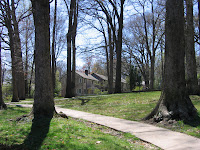
Greenbelt is laid out on a beautiful site. Two parallel streets (Crescent and Ridge Roads) follow a reverse-'c' shaped ridge. Townhouses, apartments, and single-family detached houses are spread along these roads. At the center of the reverse-'c' is a man-made lake which is surrounded by parkland. The commercial center for the city is called the Roosevelt Center. It sits at the intersection of Crescent Road and Southway, the main entrance to the development. Adjacent to the Roosevelt Center are the Municipal Buildings Recreation Center, Elementary School/Community Center, and a Public Library. The Elementary School is now closed, and the entire building is the Community Center.


All residential buildings in Old Greenbelt have their main entrances on the "garden side." The design of the community meant that pedestrian paths would through superblocks, where buildings were turned inward toward parks, gardens, and social interaction. At the rear of the units is the street, the so-called "service side."


Separated pedestrian/bicycle paths connect the different superblocks with the Center, including 3 underpasses to keep cars and people apart. These paths also wind through the parkland and around the lake.

Construction on the site began in 1935, with occupancy beginning in 1937. When the initial construction was completed, more than 800 units had been built in Greenbelt. The United States' entry into the Second World War exacerbated Washington's housing shortage and 1,000 more homes were built beginning in 1941. After the federal government began to divest itself from the community in the early 1950s, a co-operative was formed to buy the units and maintain Greenbelt's unique way of life.

Greenbelt Homes, Incorporated still owns most of the original buildings in Old Greenbelt. Partially due to its history, Greenbelters are active in community organizations. In addition to the homes, the supermarket is also a co-operative.

Greenbelt was designed with the automobile in mind, but it was not designed for the automobile. I think this is the largest and most crucial difference between Greenbelt and the prototypical post-war suburb. The community is walkable, traffic is calm, and despite being surrounded by sprawl, cars do not dominate the landscape.

I regard it as the most tragic of missed opportunities that we were unable to build America's suburbs the way we built Greenbelt. Unlike other suburbs, Greenbelt does not suffer from a lack of interaction (Bowling Alone) or a lack of alternative transportation modes.

If you're interested in learning more about Greenbelt or visiting yourself, the town opened a museum in 1987. It's open Sundays from 1-5PM, and is located across Crescent from the Public Library.

Unfortunately, neither WMATA or Prince George's County Transit provide Sunday bus service to Greenbelt. However, the town is within biking distance of the Greenbelt Metro station. During the week and on Saturdays, you can take the C2 bus from Greenbelt Station or the R12 from New Carrollton.

Back in the Blogosphere

Well, readers, I'm back. I want to apologize for my long absence here at Track Twenty-Nine. 

As you know, I did spend some time in Berlin as a part of an exchange program. Upon my return, I was caught up in helping to plan for the arrival of the Berliners. And for the last two weeks, my internet has been out at home, making it rather difficult to blog.

At any rate, I'm back and will be posting regularly again. Please bear with me, though, over the next three weeks, I'll be extremely busy with the completion of my Master's degree. Nineteen consecutive years of schooling is coming to an end, and I can see the proverbial light at the end of the tunnel. I hope it's not an oncoming train.

Please remember that you can always catch my column Wednesdays at noon on The New Gay, where I write about issues relevant to the LGBT community. 

And if you live in the Washington, DC region and are a regular Metro rider, you can help me out with one of my final projects. A classmate and I are looking at route decision-making within transit. To that end, we've set up a survey. Please find the details here. I'll post the results of the project on Track Twenty-Nine.

Friday, March 27, 2009

MAJOR Red Line Delays Tonight

Metro just announced that the Red Line is facing major delays due to the derailment of two trains between Bethesda and Medical Center. The first train stopped due to a "mechanical difficulty" while inbound toward Bethesda. When the rescue train arrived, it was discovered that the last car of the first train had derailed. Somehow, the rescue train's first car also derailed.

Passengers are currently being taken off of the first train (the rescue train was empty). Red Line trains are single-tracking around the derailments, and are sharing the same track between Friendship Heights and Medical Center.

If you're traveling on the Red Line, you should consider alternative transportation.
  • Buses L7 and L8 run north on Connecticut Avenue from Friendship Heights.
  • Buses J2, J3, & J4 run from Silver Spring to Bethesda.
  • Buses C2 and C4 run from Wheaton to Twinbrook.

Make sure to check your options on Metro's website. A Maryland bus map can be found here.

Metro Tests New Seats

Late last year, Metro introduced new wool seat coverings in two of its railcars. Five fabric patterns are being tested on cars 6026 and 6027 and the outcome of this test will influence the look of Metro's next generation of railcars. While Metro currently uses the distinctive Naugahyde seats in two different schemes, the 7000 series railcars will use only one of the five fabrics currently undergoing testing.

When Metro opened in 1976, industrial colors were in high demand. As a result, the beige interiors were complimented with brown carpet and seats in three different colors.  Originally, railcars were outfitted with orange, brown, and yellow seats. In 2001, Metro introduced three new colors for its new and rehabilitated railcars. Dubbed Potomac blue, Chesapeake sand, and Colonial burgundy, the patriotic colors were matched by a brighter white interior and red carpeting. Both sets of seats are a plastic coated vinyl polymer which is becoming increasingly hard for Metro to obtain.

The current vinyl seats are cleaned every 60 days and are replaced after one to three years depending on their condition. Replacing seats costs about $20.

Because Metro needs to find a more reliable supply of seats, they're looking toward these wool seat covers to meet their needs in the next generation of railcars. Railcars 6026 and 6027 are about halfway through their 6-month testing period. Metro announced in December that two more railcars would be outfitted with wool seats around the beginning of March, but no announcements have been made since. 

I chanced upon cars 6026 and 6027 a few weeks ago, and captured pictures of the different fabrics. I've seen the cars a few times, always on the Green and Yellow Lines. Riders on the other lines may not see wool seats until new railcars are outfitted.

Blue Squares, my favorite

Blue Dots

Red Dots

Balls and Seals

Gray Rainbows

What do you think? Have a favorite?

Bike Improvements: 9th Ave Cycle Track

Yesterday, I talked about my visit to the remade Madison Square. Also during my visit to New York, I took time to view the bicycle improvements along Ninth Avenue. These improvements have made biking along the major north-south artery safer by separating bikes from auto traffic. This project was another great improvement made by the NYC DOT under the leadership of Janette Sadik-Kahn

The Ninth Avenue Cycle Track runs from 31st Street southbound to 16th Street. Along the way, it is along the left curb of the street. It is divided from traffic by parked cars, bollards, and, at intersections, concrete islands. 


Cyclists are protected from left turns by protected left arrows at intersections. Cyclists have their own signals, which are synced with southbound through signals on Ninth Avenue. When left-turning traffic has a green arrow, cyclists are faced with a red "cycle" signal. 

Again, it seems that New York City is taking the lead in providing the street as public space for all users. Here in DC, the District Department of Transportation plans to implement a cycle track on Fifteenth Street NW. Under the reconfiguration proposal, 15th Street will be reconfigured between Massachusetts Avenue and Florida Avenue to include three northbound car lanes, one northbound bike lane (between the right-most northbound lane and the parking lane), a parking lane on each side of the street, and a southbound cycle track between the left-side parking lane and the western sidewalk. It will be separated from parked cars by a raised curb and will include north-facing signals for southbound cyclists.

Thursday, March 26, 2009

Reclaiming the Street

I recently spent a day in New York City and took the opportunity to visit Madison Square, where the NYC DOT has reclaimed portions of the roadway for pedestrians. These improvements are a part of a new set of policies implemented by Janette Sadik-Kahn which demonstrate the feasibility of remaking streets for people instead of cars.

The project at Madison Square is essentially a demonstration project. All of the work was done with temporary materials, but the effect is great nonetheless. I visited on a cold March morning so the expanded public space was not particularly busy, but folded umbrellas and stacked tables hinted at the activity one might see in warmer weather. 

The view looking south
along Broadway's former lanes

The public space at Madison Square was reclaimed by simplifying the intersection of Broadway, Fifth Avenue, and 23rd Street. By eliminating the diversion of traffic from southbound Broadway onto southbound Fifth and the diversion of traffic from southbound Fifth onto southbound Broadway, some 37,000 square feet of public plazas was created.

You can view NYC's proposal for Madison Square here.

Looking north from the 
former Broadway roadbed

Additional benefits included shorter crosswalks, more direct pedestrian routings, fewer gaps in the bike network, and simplified bus routings. The new plazas help to repair the urban fabric by encouraging pedestrians to cross Fifth and Broadway. Another improvement is the excellent viewpoint for photographers wishing to capture the Flatiron Building. But most importantly, NYC DOT has shown that reclaiming territory formerly only open to automobiles won't cause the world to end. The project is now being expanded to include Herald Square and Times Square. 

New public space west of Madison Square

Hopefully New York's dedication to returning the public right-of-way to all of the public will catch on. Many places here in Washington could certainly use road diets. Personally, I think sections of Pennsylvania Avenue between Georgetown and the White House would be good candidates for this type of public plaza. 

Tuesday, March 17, 2009

Bus Driver Appreciation Day: Tomorrow

Posted automatically while I'm out of the country

Tomorrow, Wednesday, March 18 is Bus Driver Appreciation Day. This commemorates the start of the world's first bus service in Paris, March 18, 1662. Of course, the buses back then were nothing like today's. The first bus line was organized by Blaise Pascal, but all of Paris' bus lines had vanished by 1675. So while Pascal's "wager" failed to take initially, buses were back on Parisian streets by the beginning of the 1800s. Today, they're present just about everywhere.

So you've got plenty of opportunity to appreciate your local bus driver(s).

Thanks to STB for the reminder.

Friday, March 13, 2009

Light Posting Next Week

Expect light posting over the next few days. I'll be traveling to New York City and Berlin. I look forward to updating you on my trip when I return. Thanks for reading!

Since I'll be traveling, I'll leave you with my favorite poem. It's especially apt since this post will go up at the moment my train is scheduled to leave Union Station.

"Travel" by Edna St. Vincent Millay:

The railroad track is miles away,
And the day is loud with voices speaking,
Yet there isn't a train goes by all day
But I hear its whistle shrieking.

All night there isn't a train goes by,
Though the night is still for sleep and dreaming
But I see its cinders red on the sky,
And hear its engine steaming.

My heart is warm with the friends I make,
And better friends I'll not be knowing,
Yet there isn't a train I wouldn't take,
No matter where it's going.